


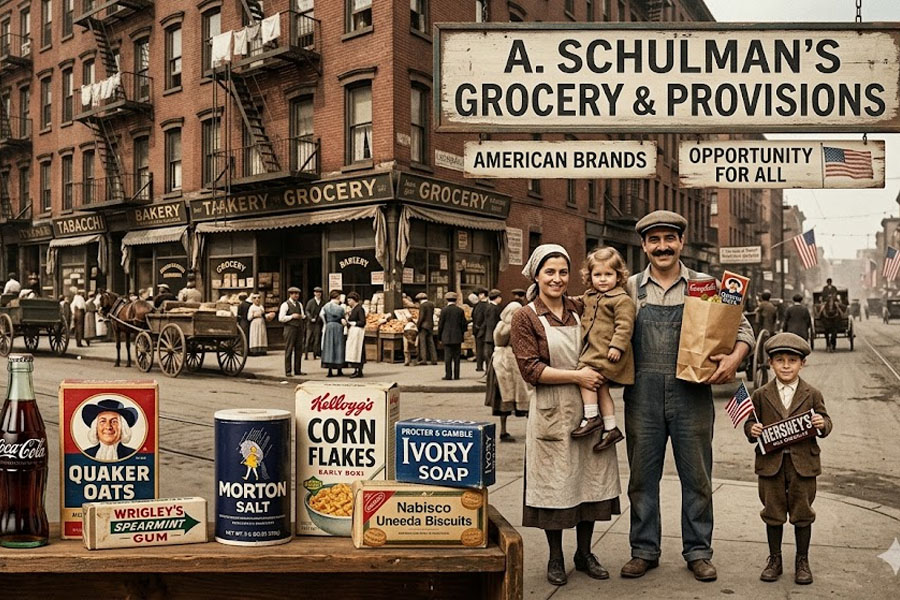
Did you know that nearly 45% of Fortune 500 companies in the U.S. were founded by immigrants or their children? These enterprises, known as “New American” companies, generate more than $8 trillion in revenue — a figure that exceeds the GDP of many developed nations. Behind every familiar product — from a tube of lipstick to a pair of jeans — lies a thrilling success story that began with ambition and hard work.
Levi’s: The Riveted Revolution
The story of the most recognizable American denim brand began in 1853 when Levi Strauss, an immigrant from Bavaria, arrived in San Francisco during the Gold Rush. Initially, his business was a dry goods wholesale operation.
The real breakthrough came nearly 20 years later when a Nevada tailor named Jacob Davis (an immigrant from Latvia) proposed a partnership to Levi. Davis had the idea of adding copper rivets to the pockets of work pants for durability. On May 20, 1873, they were granted a patent for this invention, creating the “blue jeans” we know today. The legendary Two Horse logo was created in 1886 as a symbol of the product’s strength.
Heinz: The King of Ketchup
Henry John Heinz, the son of German immigrants, was a master of marketing and meticulousness. He began his journey at age 9, selling horseradish from the family garden. After the bankruptcy of his first company, Heinz did not give up and introduced his tomato ketchup to the world in 1876.
Heinz was an innovator: he was the first to use glass packaging so that customers could see the cleanliness and quality of the product. The famous “57 Varieties” slogan was born by chance — Heinz saw a shoe ad that said “23 styles” and decided the number 57 sounded catchy, even though he already had over a hundred products at the time. Furthermore, he actively fought for clean food, supporting the Pure Food and Drug Act of 1906.
Estée Lauder: The Queen of Cosmetics
The founder of the beauty empire, Estée Lauder, was born to Hungarian immigrants and spent her life striving to be “100 percent American”. She learned skin care secrets from her uncle, a chemist who brewed creams in a stable behind their house.
Estée revolutionized marketing by inventing the “gift with purchase” concept. Her Youth-Dew fragrance, launched in 1953 as a bath oil, allowed women to buy perfume for themselves rather than waiting for it as a gift from men. Today, her company owns giants such as Clinique, MAC, and Origins.
The Russian-Speaking Legacy in America
Many brands we considerquintessentially American have roots in Eastern Europe:
- Max Factor: Founded by Maximilian Faktorowicz from Poland, who worked as a makeup artist at the Bolshoi Theatre before emigrating.
- Timberland: Created by Nathan Swartz, the son of shoemakers, whose family moved to the U.S. at the start of World War I.
- Google: One of the founders, Sergey Brin, was born in Moscow and moved to the U.S. in 1979.
- Metro-Goldwyn-Mayer (MGM): The famous Louis B. Mayer, who made the studio prestigious, was born in Minsk.
These stories prove that great brands are born from the courage to leave an old life behind and create something new in a new land.