


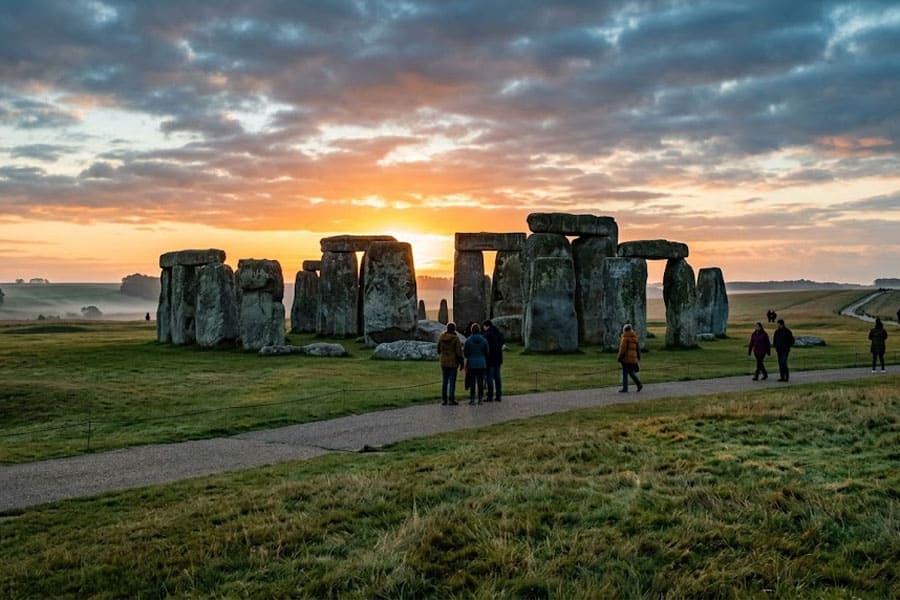
Stonehenge Mystery Solved? The Truth About the Ancient Megalith
For decades, Stonehenge was considered one of history’s most unfathomable mysteries. This majestic monument on Salisbury Plain in England inspired countless theories—from mystical Druid rituals to extraterrestrial intervention. However, recent research conducted by the world’s leading archaeologists and geologists shows that the real story of Stonehenge’s construction is far more exciting and large-scale than any fiction. Today, we can say with confidence that this monument was not the work of a local tribe; it was the result of unprecedented cooperation among peoples from across ancient Britain.
The latest scientific data obtained in 2024 and 2025 has overturned our understanding of the logistics and social connections of Neolithic people. Mineral analysis of the stones and DNA of the builders allow us to literally “see” those who erected these monoliths. Stonehenge turned out to be not just a stone circle, but the centerpiece of a vast sacred landscape linking the world of the living and the world of the dead through a complex system of roads, settlements, and ritual centers. It was a kind of “microcosm” of all Britain, bringing together materials and people from the most remote corners of the island.
For us today, understanding these processes is not just about studying ancient stones. It is a story of human determination, engineering genius, and the ability to unite for a common goal that exceeds the capabilities of a single generation. Unraveling the mysteries of Stonehenge helps us better understand the origins of European civilization and the deep cultural ties that existed on the continent thousands of years before the first states appeared. Let’s dive into the details of how modern technology helped scientists hear the voice of antiquity.
The Scottish Trail: The Mystery of the Altar Stone
The loudest recent discovery was establishing the true origin of the Altar Stone—a massive six-ton sandstone block lying at the very center of the monument. For a long time, it was believed that it, like the “bluestones,” was brought from Wales. However, in August 2024, a team of researchers led by Anthony Clarke of Curtin University published data that shocked the scientific community. Analysis of zircon, apatite, and rutile crystals showed that this stone could only have been sourced from northeastern Scotland, in the Orcadian Basin.
This means that ancient builders transported the giant block over a distance of more than 750 (and possibly up to 1000) kilometers. In an era without wheeled transport, metal tools, and written language, such a task seemed impossible. Nevertheless, geological studies of the soil around Stonehenge completely ruled out the theory that the stones could have been brought by a glacier. The absence of a specific “mineral trail” in local rivers proves: the delivery of the megalith was a conscious and incredibly complex human endeavor.
Interesting facts about the origin of the stones:
- The Altar Stone was brought from the Highland region or the Orkney Islands, 750+ km from the monument.
- The famous “bluestones” arrived from the Preseli Hills in West Wales (225 km).
- Huge sarsens weighing up to 30 tons were sourced from West Woods, just 25 km north.
- The Altar Stone is “Old Red Sandstone,” unique to northern latitudes.
For scientists, this discovery raised two fundamental questions: how and why? Delivering a stone of this weight required either powerful sea vessels capable of navigating the British coast or highly complex land logistics through dense forests and mountains. The very fact that the stone was taken specifically from Scotland emphasizes its special spiritual or political significance. Perhaps it was a gift from northern tribes or a symbol of an alliance sealed by joint construction.
Complex term explanation: Uranium-lead dating is a method for determining the age of minerals based on the analysis of radioactive uranium decay. Since the rate of this decay is strictly constant, scientists can use it as “atomic clocks” to find out with a precision of millions of years when a rock was formed.
Unification Theory: History’s First National Project
Professor Mike Parker Pearson, a leading Stonehenge researcher, proposed a revolutionary “unification theory.” According to his hypothesis, the monument was built not as a temple to a single deity, but as a political manifesto. Around 2500 BC, the indigenous peoples of Britain faced the arrival of new settlers from continental Europe—representatives of the Bell Beaker culture, who brought metallurgy and new customs.
In response to these changes, the scattered tribes of the island decided to create something grand to declare their unity and right to the land. Stonehenge became a “microcosm” of Britain: stones from Wales, Scotland, and southern England, gathered in one place, symbolized the union of different regions and ancestors. It was a project of national scale involving thousands of people, possibly speaking different dialects but united by a common faith.
Evidence for the unification theory:
- Uniqueness of sources: No other of Britain’s 900 stone circles uses stones from such distant locations.
- Diversity of burials: Isotopic analysis of remains showed that people buried at Stonehenge had lived in Wales, Scotland, and other parts of the island.
- Architectural borrowings: The horizontal placement of the Altar Stone resembles the “recumbent” stone circles characteristic only of northeastern Scotland.
- Scale of settlement: Durrington Walls nearby could house up to a thousand dwellings, making it the largest settlement in Northern Europe at the time.
This historical case proves that humanity already possessed a complex social structure 5000 years ago. Moving and erecting the stones required not just muscle, but outstanding leadership, coordination, and a supply system. This debunks the myth of “primitive” hunter-gatherer ancestors. The builders of Stonehenge were masters of astronomy, capable of tracking solar and lunar cycles with mathematical precision.
Analogy: Building Stonehenge can be compared to constructing a modern Olympic facility or funding an international space project. People invested colossal resources not in personal wealth, but in creating a symbol meant to outlast centuries and unite future generations.
Durrington Walls: Where the Builders Feasted
Three kilometers from the stone circle, archaeologists discovered the settlement of Durrington Walls, which sheds light on the daily life of ancient people. Investigation of this area showed that Stonehenge did not stand alone. It was a vast sacred complex linked by roads to the River Avon. Durrington Walls was a “place for the living” where people gathered for grand festivals, while Stonehenge itself, built of eternal stone, served as a monument to the ancestors and the world of the dead.
Excavations revealed thousands of animal bone fragments—mostly from pigs and cattle. Analysis of the animals’ teeth showed they were slaughtered at around 9 months old, which coincides with the winter solstice. This indicates massive winter feasts attended by people from across Britain, bringing their livestock from as far as Devon and Scotland hundreds of kilometers away.
Daily life and customs of the builders:
- Diet: Pork and beef were cooked in residential zones, while ceremonial spaces mainly used dairy products.
- Hygiene and disease: Parasite traces found in preserved feces suggest the consumption of undercooked internal organs.
- Homes: Neolithic dwellings had clay floors, central hearths, and even spots for wooden beds and dressers.
- Cultural similarity: The layout of houses at Durrington Walls strikingly matches those at the Skara Brae settlement in the Orkney Islands, confirming strong north-south links.
A recent reconstruction of a Neolithic hall by English Heritage allowed us to see these 7-meter-high structures firsthand. These were gathering places where “competing” teams of builders could rest together. A bold theory suggests that the stone transport itself might have been a form of ancient sporting rivalry between different groups, adding an element of festival and contest to the super-complex work.
Complex term explanation: Strontium isotope analysis is a method for discovering where a person or animal spent their childhood. Strontium enters the body via water and food and is “recorded” in tooth enamel. Every region has its own soil chemical profile, so teeth act as a natural passport indicating the place of birth.
Comparison of Stonehenge Stone Sources and Types
|
Stone Type
|
Origin
|
Distance to Stonehenge
|
Weight & Characteristics
|
|---|---|---|---|
|
Sarsens
|
West Woods, Wiltshire
|
25–32 km
|
Up to 30–45 tons, silcrete sandstone
|
|
Bluestones
|
Preseli Hills, Wales
|
225 km
|
2–4 tons, volcanic rocks
|
|
Altar Stone
|
Orcadian Basin, Scotland
|
750–1000 km
|
6 tons, Old Red Sandstone
|
Moon, Sun, and Prototypes: New Faces of Architecture
For a long time, it was believed that Stonehenge was oriented only toward the Sun—the sunrise on the summer solstice and the sunset on the winter solstice. But 2024 studies opened a new chapter: the connection to lunar cycles. Scientists found evidence that some elements were installed to track a phenomenon known as the “major lunar standstill,” which occurs every 18.6 years.
During this time, the Moon reaches its extreme points on the horizon, and ancient people seemingly attached great importance to this. The rectangular arrangement of four sarsen “station stones” perfectly matches the direction of the Moon’s rise and set during these periods. This proves that Stonehenge was not just a cemetery or temple, but a sophisticated astronomical observatory.
Furthermore, archaeologists found a possible “prototype” for Stonehenge. A site called “Stone Plates” in Dorchester, dating to 3200 BC, was built several centuries before the main monument. It features a perfectly circular ditch and may have served as inspiration for those who later created the masterpiece on Salisbury Plain.
Practical takeaways from new discoveries:
- Astronomy: Our ancestors could predict rare celestial events decades in advance.
- Idea evolution: Great monuments didn’t appear out of nowhere; they resulted from hundreds of years of architectural experiments.
- Past medicine: Neolithic times already had complex ritual and possibly healing practices involving “healing” stones from remote places.
- Communication technology: Coordinating such builds required a system for passing information over hundreds of kilometers, indicating high intelligence.
While many riddles are solved, Stonehenge continues to surprise. We still don’t know exactly what prayers were spoken between these stones or why this great project was eventually abandoned. Perhaps the answer lies in the gradual replacement of the local population by migrant tribes, and Stonehenge became the last, grandest monument to the fading Neolithic era.
Conclusions
Summarizing modern Stonehenge research, five key points change our understanding of history:
- The Altar Stone was brought from Northeast Scotland, traveling over 750 km, proving the incredible logistics of ancient Britons.
- The glacial theory of stone transport is completely debunked; megaliths were moved solely by human effort, possibly via a sea route.
- Stonehenge was a national unification project meant to unite Britain’s tribes in the face of external changes.
- Durrington Walls served as the hub for massive winter festivals where people from across the island feasted during solstices.
- The monument is a complex astronomical instrument oriented not only toward the Sun but also rare lunar cycles.
FAQ: Frequently Asked Questions
1. Why did scientists conclude the Altar Stone is from Scotland? This was proven using chemical analysis of mineral grains (zircon and apatite) inside the stone. Their composition forms a unique “geological fingerprint” that matches only rocks from the Orcadian Basin in Scotland and radically differs from stones in Wales or England.
2. How could people carry a 6-ton stone for 800 kilometers without wheels? The primary theory is a sea route. The stone could have been transported on rafts or special vessels along the coast. If moved by land, wooden sleds and log rollers were used, requiring hundreds of people and coordination between tribes along the entire route.
3. Was Stonehenge built by Druids? No, this is a common misconception. Stonehenge was mostly completed by 2100–1600 BC, while Druid culture appeared in Britain much later, in the Iron Age. Druids might have used the monument for rituals, but they were not its builders.
4. Why were people buried at Stonehenge? Stonehenge was its era’s largest cemetery. Remains of at least 50 people (mostly cremated) were found. Scientists believe elites or people from different regions involved in the construction were buried here to solidify their link to this sacred site.
5. What is “Bluestonehenge” and how does it relate to Stonehenge? Bluestonehenge (or Bluehenge) is a smaller stone circle 25 meters in diameter found by the River Avon. It consisted of the same bluestones as Stonehenge and served as a “gateway” or intermediate point on the ritual path from Durrington Walls to the main monument.
6. Is it true the stones were delivered as part of a competition? This is a bold modern theory. Given the stones’ weight, an element of sporting rivalry between teams could have been a powerful incentive for such hard work. Reconstructed feasting halls could have been spots where “teams” celebrated their success.
7. Does the Moon affect the stones’ positioning? The stones were set to mark the Moon’s rising and setting points. This specifically applies to the four “station stones” forming a rectangle. They allow observation of the “major lunar standstill”—a rare event every 18.6 years when the Moon moves differently than usual.
8. Who were the “Bell Beaker” people and what did they change? These were migrants from continental Europe arriving around 2500 BC. They brought copper and gold items, and a culture of individual burials. Their arrival, per Mike Parker Pearson’s theory, prompted locals to unite and rebuild Stonehenge as a symbol of their identity.ф