

The Twin Shadow of Giza: Does a “Second Sphinx” Lie Beneath the Sands of Egypt?
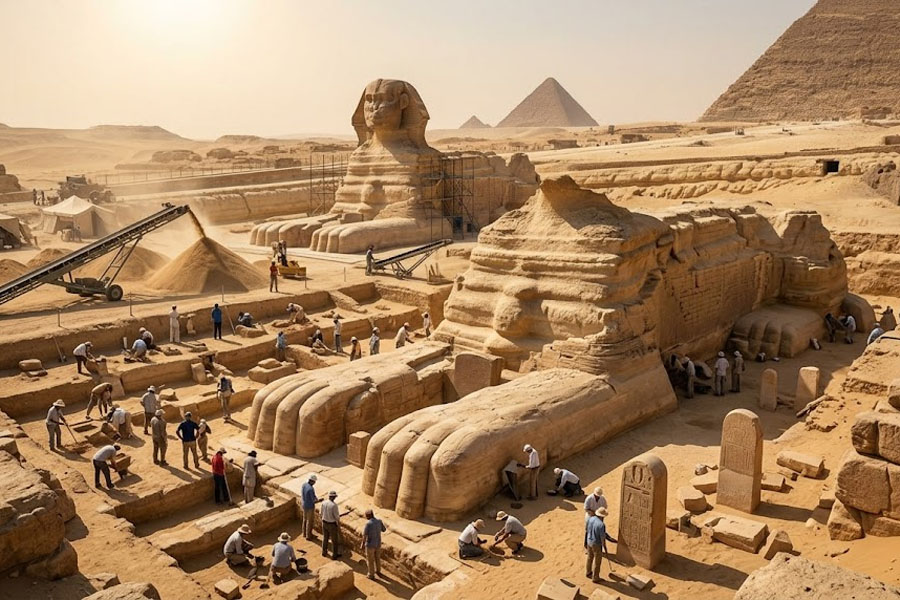
The Giza Plateau is a place where history is literally frozen in stone. However, behind the facade of the Great Pyramids and the majestic Sphinx, secrets may be hidden that will overturn our understanding of the Old Kingdom. Recent statements by researchers about the possible discovery of traces of a “second Sphinx” have sparked a new wave of interest in Egyptology. The idea that the famous guardian of the pyramids had a partner is not new, but modern technology is allowing us to peer through the layers of sand and rock with incredible precision for the first time.
Sensation or Myth? Why Scientists Seek a “Pair” for the Great Sphinx
The theory of a second Sphinx’s existence is based not only on accidental anomalies detected by radars but also on the deep philosophical and religious logic of the ancient Egyptians. The principle of duality permeated all aspects of Egyptian life: Upper and Lower Egypt, life and death, day and night.
- The Maat Principle: The concept of cosmic balance required symmetry in everything, especially in sacred architecture.
- Lion Mythology: Ancient Egyptian texts frequently mention twin lions (Aker) guarding the entrance and exit of the underworld.
- Iconography: On many ancient stelae, Sphinxes are depicted in pairs, facing opposite directions—East and West.
- Geological Data: Rock formations have been found on the Giza Plateau whose shapes suspiciously resemble the eroded remains of a massive sculpture.
Historical Evidence: What Do Ancient Texts Say?
One of the strongest arguments for the “Second Sphinx” theory is the famous “Dream Stele,” erected by Thutmose IV between the paws of the Great Sphinx. This granite slab depicts two Sphinxes, which many researchers consider not an artistic device, but an accurate reflection of the reality of that time.
- New Kingdom texts mention two lion figures guarding the sacred territory.
- Medieval Arabic historians (such as Al-Maqrizi) wrote of a destroyed Sphinx statue on the other side of the Nile or in another part of the plateau.
- Erosion analysis of the Great Sphinx shows that the monument was submerged or in an extremely wet environment for a long time, which could have destroyed a less durable neighbor.
Comparative Analysis: The Great Sphinx vs. The Hypothetical Twin
To understand the scale of this potential discovery, it is necessary to compare the characteristics of the known monument with the parameters of the proposed find, based on GPR and satellite imagery data.
| Characteristic | Great Sphinx (Existing) | Second Sphinx (Hypothetical) |
|---|---|---|
| Material | Monolithic Limestone | Limestone or Sandstone |
| Orientation | East (Sunrise) | West or South (Sunset/Boundary) |
| Estimated Age | ~4500 years (IV Dynasty) | Could have been destroyed in an era of cataclysms |
| Condition | Restored | Buried under layers of sand and sediment |
| Symbolism | Guardian of the Solar Sunrise | Guardian of Sunset and the transition to Duat |
Technology in the Service of Archaeology: Hunting for Hidden Structures
Modern archaeology no longer relies solely on shovels and pickaxes. In the search for the second Sphinx, scientists use a suite of non-invasive methods that allow them to “see” through the earth.
- Ground-Penetrating Radar (GPR): Allows for the detection of voids and changes in rock density at depths of up to 15-20 meters.
- Satellite Spectroscopy: IR imagery reveals thermal anomalies indicating the presence of stone structures beneath the sand.
- Seismic Tomography: Helps define the boundaries of man-made objects hidden behind natural rock formations.
Why Does Official Egyptology Remain Skeptical?
Despite the allure of the theory, Egypt’s Ministry of Antiquities urges caution. Many “anomalies” taken for the paws or body of a Sphinx may turn out to be natural limestone ridges, which are abundant on the Giza Plateau. Furthermore, over millennia, the plateau’s landscape has undergone significant changes due to stone quarrying for pyramid construction, which could have erased any traces of a twin monument.
Impact on Modernity: Why Look for a Second Sphinx?
The discovery of such an object would be the largest archaeological event of the 21st century. It would not only confirm the concept of duality in Egyptian architecture but also provide new keys to understanding the astronomical orientation of the plateau. Perhaps the second Sphinx is the key to finding the “Hall of Records”—the legendary library of Atlanteans or ancient knowledge written about by mystics of past centuries.
FAQ: Frequently Asked Questions about the Second Sphinx
- Where exactly could the second Sphinx be located? Main hypotheses point to a hill south or southwest of the Great Sphinx, or on the opposite bank of the river.
- Is it true that the “Dream Stele” depicts two Sphinxes? Yes, a mirrored image of two Sphinxes is the central decorative element of this stele.
- Who first proposed this theory? One of the most famous proponents is Egyptologist Bassam El Shammaa, who has studied this issue for over 10 years.
- Why might the Sphinx have been destroyed? The cause could have been lightning (mentioned in ancient texts) or the low quality of limestone in that specific part of the plateau.
- Are robots used in the research? Yes, small-scale drones and probes are used to explore narrow shafts within the plateau.
- How will this change history? It will confirm that the Giza complex was built as a single sacred mechanism rather than separate tombs.
- When can we expect official excavations? Preliminary studies are currently underway; full-scale excavations require approval from Egypt’s Supreme Council of Antiquities.
- Is there a connection to the Great Pyramid? All objects on the plateau are believed to be linked by a unified astronomical and religious plan.
- Did ancient Egyptians consider the Sphinx to be alive? Yes, it was worshipped as the embodiment of the god Haurun-Haremakhet (Horus on the Horizon).
- Could it just be a natural rock? Many scientists lean toward this version, considering the “anomalies” a play of nature and imagination.