

Secrets of the Great Steppe: How Archaeologists Uncovered a “Lost World” Beneath Kazakhstan’s Soil
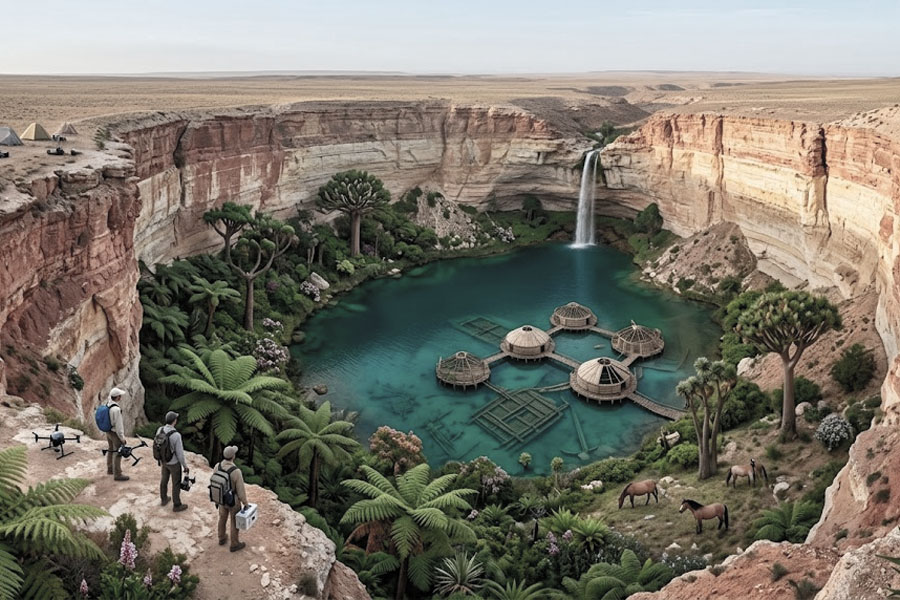
The Kazakh steppe, long considered merely a transit corridor for nomadic hordes, has once again left the global scientific community in awe. Recent archaeological surveys have led to the discovery of an entire complex of structures that scientists have already dubbed a “lost world.” Hidden beneath layers of soil and weathered rock, these structures point to a highly developed civilization that possessed unique knowledge in architecture and geodesy long before the rise of many well-known empires.
Subterranean Cities: What the Steppe Hid for Millennia
The discovery in the western and central parts of Kazakhstan represents not just isolated burials, but a sophisticated system of settlements and ritual sites. The uniqueness of this “lost world” lies in the fact that it is virtually invisible from the surface, allowing it to escape looting for centuries. Researchers emphasize that these objects change our perception of nomads as people who lacked permanent architectural traditions [1, 3].
- Geoglyphs and Earthworks: Large-scale figures visible only from high altitudes, likely used as astronomical markers.
- Subterranean Temple Complexes: Chambers carved into bedrock with unique ventilation and lighting systems.
- Sophisticated Irrigation Networks: Evidence that ancient steppe dwellers successfully practiced agriculture in arid regions.
- Metallic Artifacts: Gold and bronze finds executed in the “animal style,” featuring elements characteristic of settled Eastern cultures.
Historical Context: Who Were the Creators of This Civilization?
According to preliminary data and radiocarbon analysis, most of the objects date back to the Early Iron Age (the period of the Saka and Sarmatians), though some layers root back to the Late Bronze Age. This was an era of great transformation, when steppe peoples not only fought but also established powerful trade and cultural hubs on the prototype of the Great Silk Road [3].
- The Saka and Their Legacy: Tribal groups with a complex social hierarchy and outstanding craftsmanship in jewelry.
- Persian Achaemenid Influence: Artifacts indicate a close exchange of technologies between the steppe and the great empires of the South.
- Spiritual Culture: The layout of settlements indicates profound knowledge of cosmogony and reverence for solar cycles.
Comparative Analysis: Steppe Civilization vs. Well-Known Cultures
To understand the scale of this discovery, we have prepared a table comparing the characteristics of the found world with other famous Eurasian archaeological sites [2, 3].
| Characteristic | Kazakhstan’s “Lost World” | Arkaim (Southern Urals) | Pazyryk Culture (Altai) |
|---|---|---|---|
| Type of Structures | Subterranean complexes and geoglyphs | Fortified settlements (“City-Observatory”) | Kurgan burials in permafrost |
| Primary Material | Stone, compacted soil | Wood, clay | Wood, ice |
| Dating | 8th century BCE — 3rd century CE | 21st — 18th centuries BCE | 6th — 3rd centuries BCE |
| Key Feature | Landscape concealment (invisibility effect) | Circular planning | Unique preservation of organic matter |
Technologies of “Invisible” Architecture
One of the most intriguing details is the mastery of camouflage. Ancient architects used natural relief curves and specific types of soil to hide the entrances to their shelters and temples. This suggests a high level of military threat at the time or the sacred, exclusive nature of these locations [3].
- Use of light wells to illuminate subterranean halls.
- Application of natural sorbents to maintain dryness in the chambers.
- Creation of false corridors and traps to protect against uninvited guests.
Impact on Modernity and Science
The discovery of this “lost world” in Kazakhstan poses new questions for historians. This find confirms that the Steppe was not just a place for nomadic movement but a cradle of unique engineering solutions. Modern satellite monitoring and LiDAR scanning methods allow us today to see what has been hidden from the eyes of researchers for over two thousand years [3].
FAQ: Frequently Asked Questions about the Kazakhstan Discovery
- Where exactly in Kazakhstan was the “lost world” found? Research covers several zones, including the Mangystau region and parts of the Turgay Trough.
- Why is it called a “lost world”? Because most structures are hidden underground and lack visible surface architecture.
- Is this related to the “Golden Man”? Yes, the culture of the creators of these sites is related to the one that left the famous Saka kurgans.
- How did scientists find these sites? Using aerial photography and LiDAR technology, which allows them to see through vegetation and soil layers.
- Is it true that there are pyramids in Kazakhstan? Stepped mausoleums (like the Saryarka Pyramid) have been found in the steppes, which are comparable in age to the Egyptian ones.
- What is the primary value of these finds? It is proof of sedentism and a high engineering level among the ancient inhabitants of Kazakhstan.
- Can tourists visit these excavations? Most sites are in hard-to-reach locations and are closed due to ongoing scientific work.
- Will treasures be found? Archaeologists have already discovered a significant amount of gold items crafted using unique techniques.
- Who funds the research? Excavations are carried out under Kazakhstan’s state programs with the participation of international experts.
- What is the age of the oldest object? The earliest structures date back to the Bronze Age, making them over 3,000 years old.