

Six Millennia in Stone: How the 6,500-Year-Old Texas Mountain “Time Capsule” Rewrites Human Survival History
Archaeology is often associated with monumental pyramids or golden masks, but truly revolutionary discoveries sometimes manifest as a collection of dry leaves and fragments of fiber. In the arid Trans-Pecos mountains of West Texas, scientists have uncovered a unique rock shelter that has served as a genuine 6,500-year-old “time capsule.” Due to a specific microclimate, organic artifacts that usually vanish without a trace within decades have been perfectly preserved. This find is not merely a cache of ancient debris; it is a detailed chronicle of human adaptation to extreme desert conditions long before the first cities of Mesopotamia rose. We analyze the molecular composition of these finds and explore what biohacking and resilience lessons we can learn from the people of the Middle Archaic period.
Natural Preservation: Why the Texas Mountains Defied Time
The success of this discovery is attributed to the unique geological structure of these rock overhangs. Unlike open-air sites, these shelters create an environment virtually devoid of moisture and bacterial activity.
- Stable Hygroscopicity: Limestone walls absorb residual moisture, acting as a natural dehydrator for the interior space.
- UV Protection: Deep niches shield organic matter from the destructive effects of solar radiation and photolysis.
- Thermal Stability: The stone’s thermal mass prevents sharp temperature fluctuations that would otherwise cause artifacts to crack.
- Anaerobic Conditions: Dense layers of dust and botanical remains (middens) create oxygen-deprived conditions that mummify tissues and fibers.
4500 BCE Technology: From Woven Sandals to Complex Diets
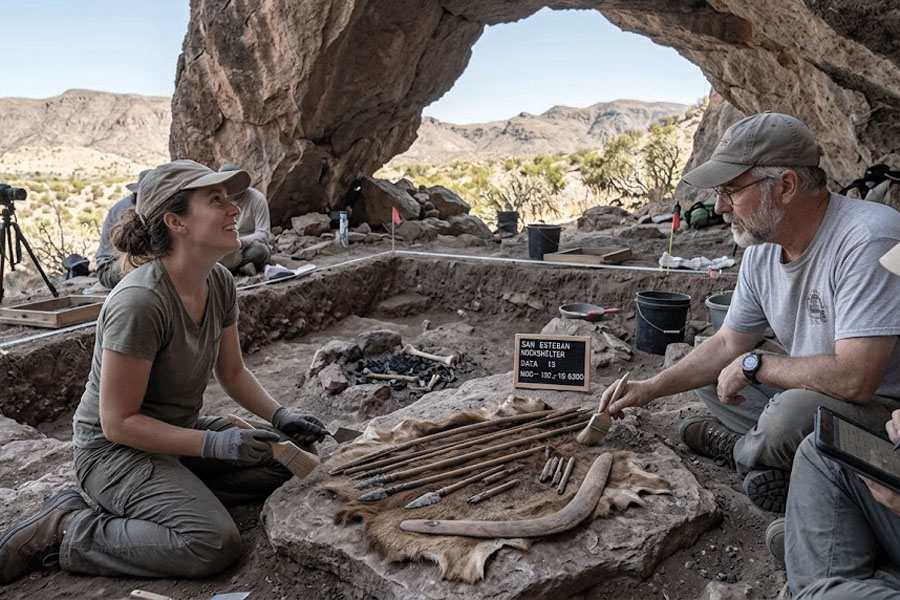
The artifacts within the Texas “capsule” are stunning in their detail. Archaeologists have recovered household items that allow for the reconstruction of the daily survival rituals of ancient hunter-gatherers with hour-by-hour precision.
- Textile Mastery: Fragments of mats and sandals woven from Yucca and Lechuguilla fibers demonstrate a sophisticated understanding of tensile strength and material science.
- Earth Ovens: Hearth remains with traces of roasted Sotol roots indicate the use of long-term pit-cooking technologies to break down complex carbohydrates.
- Coprolite Analysis (Fossilized Biomaterial): By analyzing these remains, scientists reconstructed a diet including over 20 plant species, small rodents, and even insects.
- Precision Tools: Bone needles and stone scrapers found still bearing DNA traces of the animals hunted by the mountain inhabitants.
Comparative Chronology: The Texas Find in a Global Historical Context
To grasp the profound antiquity of this site, we have designed a table comparing the Texas “time capsule” with key milestones of human civilization.
Çatalhöyük SettlementTurkey9,000 YearsModerate (Clay and charred remains)
| Site / Event | Location | Approximate Age | Condition of Organics |
|---|---|---|---|
| Trans-Pecos Rock Shelter | Texas, USA | 6,500 Years | Pristine (Fibers and food preserved) |
| Great Pyramid of Giza | Egypt | 4,500 Years | Partial (Stone and mummies) |
| Stonehenge | United Kingdom | 5,000 Years | Poor (Only stone and bone) |
| Ötzi the Iceman | Alps | 5,300 Years | Unique (Frozen) |
Desert Social Glue: How Ancient Communities Thrived
The Texas discovery shatters the myth of the “primitive” nomadic tribe. The artifacts provide evidence of a sophisticated social structure and deep botanical knowledge passed down through generations.
- Division of Labor: Wear patterns on tools indicate specialization among stone tool makers and master weavers.
- Seasonal Migration: Pollen analysis in soil layers confirms that groups returned to this shelter during specific plant-blooming cycles.
- Ritual Expression: Finds of painted pebbles and rock art fragments suggest a complex system of beliefs and cosmology.
Modern Impact: Lessons from the Past for Future Biohacking
Why does a 6,500-year-old discovery matter today? Studying the diet and lifestyle of people who lived under strict resource constraints provides modern nutritionists with unique data on human metabolic capabilities.
- The Real Paleo Diet: Data from Texas shows that ancestors consumed massive amounts of fiber, maintaining a diverse and robust gut microbiome.
- Stress Resilience: Skeletal studies confirm high adaptability to physical exertion and extreme thermal stress.
- Ecological Wisdom: Ancient Texans utilized desert resources without depleting them, serving as a benchmark for sustainable development.
FAQ: Frequently Asked Questions about the Texas “Time Capsule”
- What exactly is meant by an archaeological “time capsule”? It refers to a dry, isolated rock shelter where organic materials—clothes, food, and tools—were naturally mummified.
- Is the 6,500-year age verified? Yes, radiocarbon dating of charcoal and plant fibers confirmed a date in the Middle Archaic period.
- What were the most unusual items found? Grass sandals that look nearly wearable and the remains of ancient flatbreads.
- Who inhabited these mountains at that time? Groups of hunter-gatherers who adapted to the desert environments of West Texas and Northern Mexico.
- Does this help us understand American history? Absolutely. it proves complex cultures existed in North America long before the Maya or Aztec civilizations.
- How do scientists know what they ate? Through the analysis of coprolites, which contain preserved fragments of undigested food and pollen.
- Can the public visit these sites? Most are on private land or restricted areas to prevent looting and preserve delicate archaeological layers.
- Is climate change affecting these finds? Unfortunately, yes. Increased humidity can lead to the rapid decay of organic remains that have not yet been excavated.
- Was any DNA recovered? Modern techniques allow for the extraction of DNA fragments from bone and even plant fibers to track migration.
- What is the primary medical significance? Studying ancient microbiomes helps researchers understand the root causes of modern metabolic diseases.