

The Mysteries of Scottish Crannogs: How 5,000-Year-Old Man-Made Islands are Rewriting Neolithic History
Archaeology is often perceived as a science of digging through dry earth, but some of the most breathtaking modern discoveries are hidden beneath the dark, peaty waters of Scottish lochs. The discovery of man-made islands, known as crannogs, in the Outer Hebrides—dating back over 5,000 years—has sent shockwaves through the scientific community. Until recently, these engineering marvels were thought to belong exclusively to the Iron Age. However, radiocarbon dating of Neolithic pottery found on the lakebeds has proven otherwise: ancient Scots were constructing artificial islands long before the first pyramid was laid in Egypt. This is not just an archaeological find; it is evidence of extraordinary engineering skill and social organization among Neolithic peoples. We will explore how these “lake fortresses” were built and why our ancestors chose to move away from the shore and into the deep water.
Neolithic Engineering Genius: Building Islands Without Modern Machinery
Creating a crannog was a Herculean task requiring the coordination of dozens of individuals. Imagine a society manually transporting tons of rock and timber to create a stable platform in the middle of a deep loch. This required not only physical strength but a sophisticated understanding of hydrology and structural stability.
- Materials: The foundations consisted of massive boulders meticulously stacked on the loch floor. These were topped with layers of smaller stones, peat, and timber logs.
- Location Strategy: Islands were often built upon small natural shallows that were artificially expanded to the desired dimensions.
- Access Points: Most crannogs were reached via narrow stone or timber causeways, often hidden just below the water’s surface, making them invisible to outsiders.
- Preserved Artifacts: On the loch beds surrounding these sites, archaeologists find perfectly preserved Neolithic pottery, believed to have been cast into the water as part of ritual offerings.
Why the Water? The Sacred and Defensive Significance of Crannogs
For a long time, the primary theory behind crannogs was defense against predators and rival tribes. However, recent research suggests these islands were more than just refuges; they were centers of social and spiritual life for Neolithic communities.
- Status and Prestige: Owning an artificial island in the center of a loch was the ultimate symbol of power. It demonstrated a leader’s ability to mobilize significant resources and labor.
- Ritual Platforms: The isolation of the islands made them ideal for initiation rites and sacrifices related to water deities or ancestral spirits.
- Resource Protection: The surrounding water acted as a natural “refrigerator” and a barrier against rodents, allowing for the safe storage of grain and meat.
Comparative Analysis: Crannogs vs. The World’s Great Megaliths
To grasp the scale of the Scottish discovery, we have designed a table comparing crannogs with the most famous architectural monuments of the Neolithic era. This illustrates that Scotland was a pivotal center of civilization during this period.
| Site | Location | Approximate Age | Construction Type | Primary Significance |
|---|---|---|---|---|
| Scottish Crannogs | Isle of Lewis, Scotland | 3600–3300 BCE | Man-made Island | Oldest hydro-engineering in Europe |
| Stonehenge | England | 3000–2000 BCE | Megalithic Circle | Astronomical Observatory |
| Pyramid of Djoser | Egypt | 2600 BCE | Step Pyramid | First monumental royal tomb |
| Skara Brae | Orkney Islands | 3100–2500 BCE | Stone Settlement | Best preserved Neolithic domestic life |
| Newgrange | Ireland | 3200 BCE | Passage Tomb | Solar Alignment |
Discovery Methods: 21st-Century Underwater Archaeology
The identification of Neolithic crannogs was made possible through a combination of amateur diving enthusiasm and high-end technology. For decades, these sites were mistaken for natural islets until diver Chris Murray discovered piles of pottery on the loch bed.
- Aerial Photography and Drones: These allow for the identification of regular geometric shapes hidden by modern vegetation.
- Side-Scan Sonar: Scans the loch floor to reveal anomalous stone clusters that could not have formed naturally.
- Radiocarbon Dating: High-precision dating of timber piles and organic remains pushed the construction date back by over 2,000 years.
Modern Impact: Climate Change and Heritage Preservation
Scottish crannogs are essentially time capsules. Due to the lack of oxygen in the loch silt, organic materials like wood, leather, and even food remains are preserved in pristine condition. However, climate change and rising water acidity now threaten these treasures.
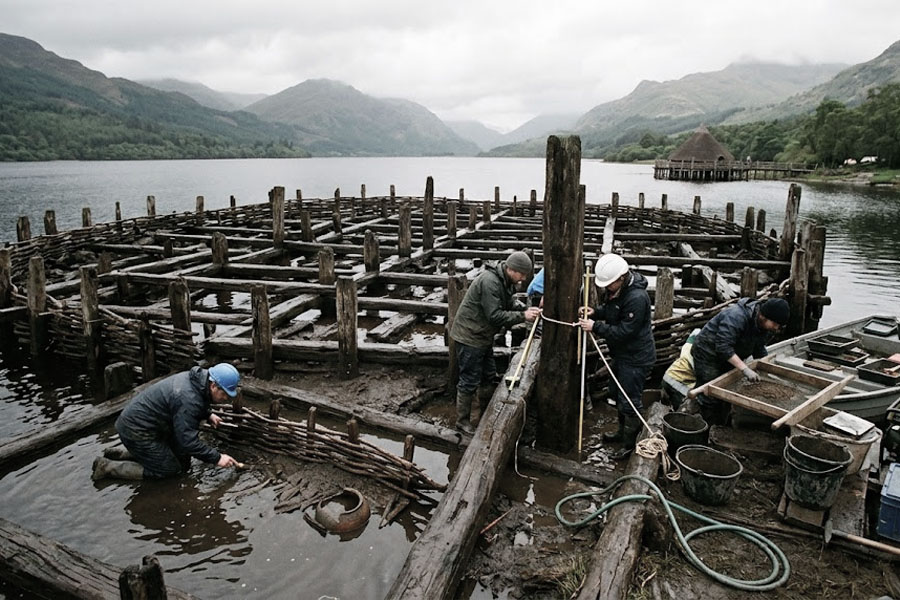
- Museumification: The reconstruction of a crannog at Loch Tay allows tourists to personally experience the atmosphere of living on the water.
- Scientific Grants: This discovery has triggered a surge in investment for UK underwater archaeology programs.
- Environmental Monitoring: The condition of these islands has become a benchmark for the health of the region’s freshwater ecosystems.
FAQ: Frequently Asked Questions about Scottish Crannogs
- What is a crannog? A crannog is a man-made island built by ancient peoples in lochs or estuaries for habitation, storage, or ritual purposes.
- Are they really older than Stonehenge? Yes, the Neolithic crannogs in the Outer Hebrides date to roughly 3600 BCE, pre-dating the initial phases of Stonehenge.
- How did pottery survive on an uninhabited island? Pottery was often cast into the water intentionally as an offering. The silt and cold water preserved it for thousands of years.
- Did people live on these islands permanently? This is a point of academic debate. Some were likely permanent residences, while others were used for specific communal gatherings.
- How many crannogs have been found in Scotland? Roughly 600 have been recorded, though only a small fraction are currently confirmed as Neolithic.
- Can I visit a crannog today? While most ancient sites look like overgrown rock piles, the Scottish Crannog Centre at Loch Tay offers a full-scale living reconstruction.
- Why build an island if there was space on the shore? Water provided security, social status, and a specific sacred connection to the environment vital to the era’s culture.
- Did they use boats for construction? Absolutely. Rafts and log boats were essential for transporting large boulders to the construction site.
- Does this discovery affect Irish history? Yes, Ireland has many crannogs, and researchers are now searching for similar Neolithic evidence there.
- What is the biggest remaining mystery of the crannogs? It remains unclear why people suddenly abandoned these islands and stopped building them for several centuries.