


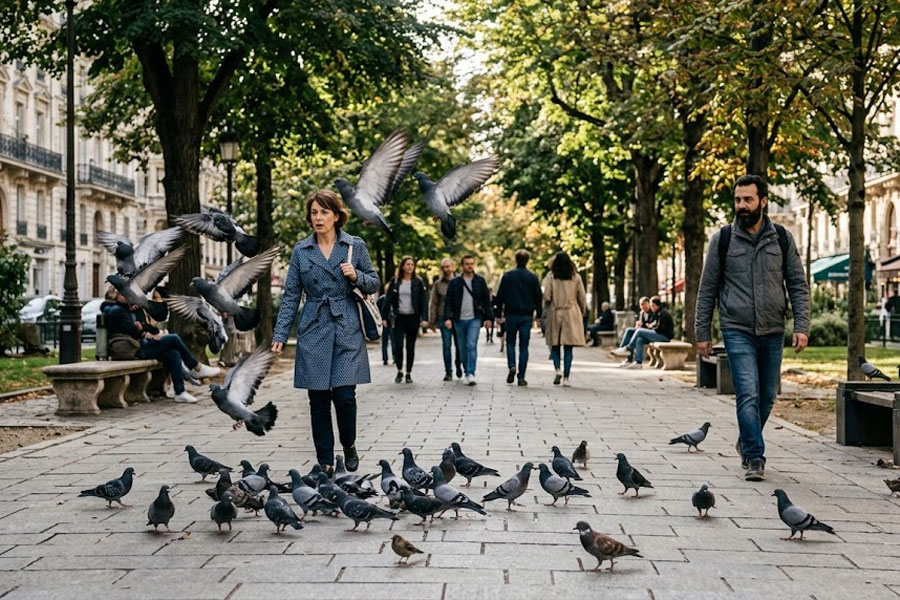
The Avian Gender Gap: Why Urban Birds Are More Wary of Women Than Men
Life in a metropolis is a constant test of adaptation, not only for humans but also for the millions of birds that share our urban spaces. Pigeons, crows, and sparrows have long mastered the art of distinguishing potential threats, but recent ornithological research has led to a startling conclusion: birds react differently to men and women. It turns out that the “flight distance” upon a woman’s approach is significantly higher. This discovery sheds light on the complex pattern recognition mechanisms in animals and forces us to reconsider how our appearance and behavior influence the urban ecosystem.
Urban Ethology: Understanding Flight Initiation Distance (FID)
To understand this phenomenon, scientists use the term Flight Initiation Distance (FID)—the critical distance at which a wild animal allows a potential predator to approach before deciding to flee. Urban birds are masters of risk calculation. They constantly balance the need to conserve energy with the risk of becoming someone’s meal. Research has shown that a human’s gender serves as one of the key signals of safety or danger for them.
- Cognitive Categorization: Birds do not simply see a “human”; they classify us based on multiple traits: gait, clothing, and even facial features.
- Adaptive Memory: Urban species pass information about dangers down through generations, forming a collective experience of interacting with city dwellers.
- Visual Markers: Walking speed and limb movement are factors that birds process in fractions of a second.
- Gender Asymmetry: Data confirms that, all else being equal, birds take flight earlier when approached by a woman.
Why Do Women Cause Greater Anxiety in Birds?
Scientists have put forward several hypotheses to explain this paradox. Although men are often perceived as larger and potentially more aggressive, biological and social factors create a different perception in the avian world.
- Gait Characteristics: Female gait is often characterized by more frequent steps and specific swaying, which birds may perceive as less predictable or more “frenetic” movement.
- Clothing Contrast: Women’s wardrobes are traditionally more diverse in terms of colors and accessories. Bright fabrics and flowing clothing elements (scarves, coat hems) can mimic the movements of predators or cause instinctive unease.
- Vocal Pitch: The higher frequencies of female voices may resemble the alarm calls of the birds themselves, shifting their nervous system into “high alert” mode.
- Previous Experience: Curiously, statistics show that women are more likely to attempt interactions with birds (either feeding them or, conversely, startling them for a photo), making them objects of increased scrutiny.
Comparative Analytics: Bird Reactions to Human Profiles
To systematize the data, researchers conducted a series of tests across various urban parks, recording FID in meters. The results clearly demonstrate the differences in perception.
| Human Profile | Average FID (meters) | Bird Stress Level | Primary Trigger |
|---|---|---|---|
| Man (Calm Pace) | 2.1 — 3.5 | Low | Steadiness, Predictability |
| Woman (Calm Pace) | 4.2 — 5.8 | Medium | Step Frequency, Clothing Details |
| Group of Children | 8.0 — 12.0 | High | Chaotic Movements, Noise |
| Runner (Any Gender) | 6.5 — 9.0 | High | High Approach Speed |
| Person with a Dog | 10.0+ | Critical | Predatory Presence |
Recognition Mechanisms: How Do Birds “Scan” Us?
A bird’s brain is optimized for rapid visual analysis. Pigeons, for instance, have a field of vision of nearly 340 degrees, allowing them to see an approaching human without even turning their heads. They utilize parallax and binocular vision to accurately gauge distance. But the most amazing feat is their capacity for individual recognition.
- Birds are capable of remembering the faces of people who have harmed them or, conversely, fed them regularly.
- They associate certain types of bags or packets with food, which decreases their flight initiation distance.
- The reaction to a “female” profile may be the result of evolutionary caution toward more socially active members of the human community.
Impact on Urban Ecology and Animal Psychology
This discovery has important implications for urban planning and nature conservation. If specific population groups cause animals more stress, it could lead to changes in migration paths within the city or the disappearance of sensitive species from park zones. We must realize that our mere presence is a constant stream of information “noise” for wildlife.
Practical Takeaways for City Dwellers
If you wish to observe birds from a close distance or help them survive the winter, it is worth considering their “gendered preferences” in perception. Calm, fluid movements and a lack of sharp contrasts in clothing will help decrease the distance of trust.
FAQ: Frequently Asked Questions about Bird Behavior
- Is it true that birds fear women more? Studies confirm that the flight initiation distance when women approach is on average 1.5–2 times higher than with men.
- What causes this reaction? Main hypotheses include differences in gait, brighter clothing, and higher vocal frequencies.
- Do birds recognize faces? Yes, crows and pigeons have proven their ability to recognize specific human faces even after several months.
- Are birds afraid of children? Yes, children cause the highest level of anxiety due to their unpredictability and sudden movements.
- How can I reduce a bird’s fear when meeting? Move tangentially, avoid direct eye contact, and prevent sudden arm movements.
- Does clothing color affect bird behavior? Absolutely. Bright colors (red, yellow) are often perceived as danger signals or “aposematic” coloration of predators.
- Do these results vary by bird species? This mostly applies to urban species (pigeons, jackdaws, sparrows). Forest birds tend to fear all humans equally.
- Can birds get used to a specific person? Yes, regular feeding while wearing the same clothes can reduce the flight initiation distance to zero.
- Why is this important for science? It helps us understand how animals adapt to life in anthropogenic environments and what stimuli they use for survival.
- Does bird behavior change at night? At night, birds rely more on hearing, and their flight distance may decrease due to poor visibility, but their stress levels rise.