

Echoes from the Abyss: How the Stones of the “Seven Wonders” Found Beneath the Sea are Rewriting Ancient History
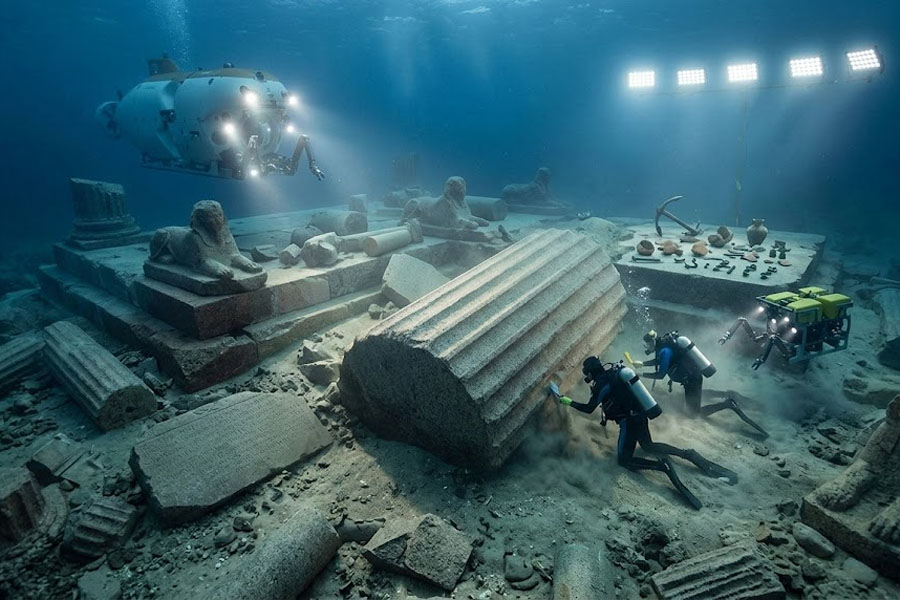
For centuries, humanity regarded the Seven Wonders of the Ancient World as irrevocably lost, their existence dismissed as half-legend, shrouded in myth. However, a recent underwater expedition has brought sensational news: massive granite and marble blocks have been discovered on the seabed, which experts believe belonged to one of the greatest engineering feats of antiquity—the Lighthouse of Alexandria (Pharos) or perhaps the legendary Colossus of Rhodes. This discovery is more than just an addition to museum collections; it compels scientists to re-evaluate the technological capabilities of ancient civilizations and their interaction with the elements. As Chief Editor, I emphasize: we are witnessing the return of physical proof of what was thought to be forever buried under the weight of water and time.
Underwater Archaeology 2026: The Technologies That Brought a Wonder Back
The discovery of such objects on the sea floor is not a matter of luck but the result of applying state-of-the-art relief scanning methods. In conditions of poor visibility and meters of sand accumulation, traditional diving search methods are ineffective. This new find was made possible by the symbiosis of satellite monitoring and underwater drones.
- Multibeam Echo Sounder (MBES): Allowed for a 3D map of the seafloor with centimeter-level precision, revealing the geometry of man-made blocks.
- Sub-bottom Profiler: Scanned through sediment layers to find massive foundations beneath five meters of silt.
- Remotely Operated Vehicles (ROVs): These drones conducted photogrammetry of the objects, creating a digital twin of the ruins without physical interference.
- Carbon Isotope Analysis: Allowed for decadal precision in confirming that the stones belong to the Ptolemaic era or the Hellenistic period of Rhodes.
Historical Context: Why Did the Wonders of the World End Up Underwater?
The history of the destruction of ancient monuments is a chronicle of catastrophes. The primary reason these architectural masterpieces are now underwater is the instability of tectonic plates in the Mediterranean region. Understanding the causes of their demise helps us better prepare for the future challenges of climate change.
- Tectonic Shifts: A series of powerful earthquakes (in 956, 1303, and 1323 AD) turned the majestic Pharos into a heap of rubble.
- Coastal Subsidence: Due to local geological processes, entire districts of ancient Alexandria, including royal palaces, submerged beneath the waves.
- Tsunamis: Massive waves triggered by undersea tremors swept monumental statues and columns directly into the harbor.
- Human Factor: The reuse of Wonder fragments as building material for forts and mosques scattered their pieces across the coastal zone.
Comparative Analysis: Reconstruction vs. Reality
To grasp the scale of the discovered fragments, it is necessary to compare their characteristics with the descriptions of ancient authors (Herodotus, Strabo) and modern scientific hypotheses.
| Characteristic | Lighthouse of Alexandria (Projected) | Colossus of Rhodes (Projected) | Discovered Remains (Artifacts) |
|---|---|---|---|
| Original Height | 120–140 meters | ~33 meters | Fragments up to 12 meters |
| Primary Material | Limestone, Granite, Marble | Bronze, Iron, Stone | Red Aswan Granite |
| Block Weight | Up to 70 tons | Unknown | Blocks weighing 50+ tons found |
| Preservation | Moderate (underwater) | Low (fragmentary) | High (protected by silt) |
| Carving Type | Greco-Egyptian Synthesis | Classical Hellenism | Hieroglyphs and Greek inscriptions |
Ancient Engineering Genius: How Did They Lift Such Weights?
The discovery of blocks weighing over 50 tons on the seabed raises a question: what mechanisms did ancient engineers possess to transport and install such structures? Modern archaeology acknowledges that ancient cranes and winches were far more complex than previously assumed.
- Compound Pulleys: Block systems that allowed the multiplication of pulling force by dozens of times.
- Transport Barges: Specialized double-hulled vessels for transporting monoliths across the Nile and the Mediterranean.
- Hydraulic Methods: Using sand and water for the precise fitting of blocks against one another.
- Metal Dowels: Connecting stones with lead and iron shims to provide seismic resistance.
The Impact of the Discovery on Modern World Culture
The return of the “lost stones” is a powerful catalyst for the development of cultural tourism and national identity in Egypt and Greece. Plans for underwater museums, where tourists can view the ruins of World Wonders in their natural (submerged) environment, are moving from the realm of science fiction to the planning stage.
- The underwater museum project in Abu Qir Bay and Alexandria.
- Utilizing VR technologies for virtual reconstruction of the Wonders atop the discovered remains.
- Strengthening international cooperation within UNESCO conventions for the protection of underwater cultural heritage.
Ecological Aspect: The Sea as a Preservative of History
Paradoxically, the very marine environment that destroyed these monuments became their best protector. The lack of oxygen in deep sediment layers and the constant temperature prevented stone decay and preserved unique carvings that would have been eroded by wind on the surface.
- Silt acts as a hermetic cocoon, protecting marble from dissolution by saltwater.
- Marine organisms (corals) sometimes create a protective calcareous layer over the artifacts.
- The absence of extreme temperature fluctuations minimizes internal stress in crystalline rocks.
FAQ: Frequently Asked Questions about the Remains of the Wonders
- Which Wonder of the World was found on the bottom? The primary finds in Alexandria belong to the Pharos Lighthouse, but potential fragments of the Colossus of Rhodes are also being investigated.
- How could stones survive for thousands of years? Many blocks were buried under thick silt, which restricted oxygen and prevented degradation.
- Will these stones be raised to the surface? Most experts recommend leaving them on the bottom for an underwater museum, as exposure to air can cause granite to crumble.
- Why did they fall specifically into the sea? The lighthouse stood on an island and collapsed into the water during earthquakes, while the Colossus snapped and fell toward the shore, with pieces later washed away or sold.
- How do scientists know these aren’t just regular rocks? The geometry of the blocks, tool marks, hieroglyphs, and the use of specific Aswan granite indicate man-made origins.
- Who funds this research? Expeditions are conducted under the ministries of antiquities of the respective countries, supported by international grants and UNESCO.
- Can tourists dive to see these stones? In certain zones of Alexandria, diving is permitted, but strictly under the control of licensed guides.
- Is it true that statues were found on the bottom? Yes, colossal statues of kings and gods that once decorated the base of the lighthouse were found near the blocks.
- Does global warming affect these finds? Yes, rising sea levels and changing salinity can accelerate the corrosion of some elements, requiring urgent documentation of the sites.
- When can we expect a full reconstruction? Digital 3D reconstructions are already available, but physical restoration at the original scale is not currently planned.