


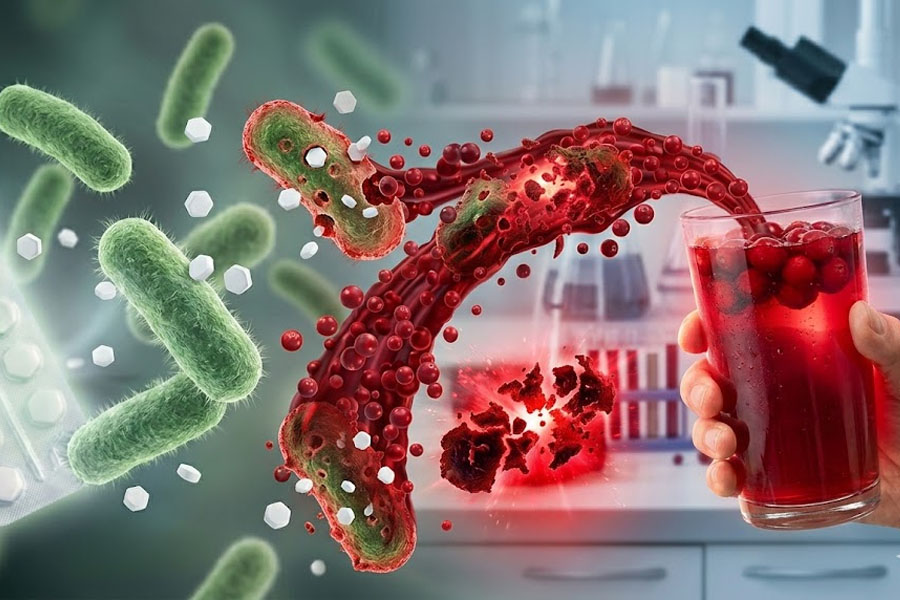
Nature’s Synergy: How Cranberry Juice Transforms Standard Antibiotics into a “Super-Drug”
In an era of rising antibiotic resistance, where standard medications are losing their battle against “superbugs,” scientists are increasingly turning to natural catalysts. One of the most promising discoveries of recent years is the proof that ordinary cranberry juice can radically enhance the effectiveness of antibiotics. This is not just folk wisdom; it is a biochemical hack of bacterial defense mechanisms. This discovery could reshape treatment protocols for urinary tract and respiratory infections, making therapy faster and safer.
Molecular Breach: How Cranberries “Disarm” Bacteria
For a long time, it was believed that cranberries were useful only because they acidified urine or created a mechanical barrier. However, deep research has shown that cranberry molecules—proanthocyanidins (PACs)—act at a much deeper cellular level.
- Adhesion Blockade: Bacteria (such as E. coli) have hair-like structures called fimbriae used to cling to organ walls. Cranberries “lubricate” these structures, preventing bacteria from anchoring.
- Increased Permeability: Components of cranberry juice make the bacterial cell membrane more fragile and permeable to antibiotic molecules.
- Suppressing Resistance “Pumps”: Many bacteria have evolved to “pump out” antibiotics immediately upon entry. Cranberry blocks these efflux pumps, trapping the medication inside the pathogen.
- Biofilm Destruction: Bacteria often form fortress-like colonies (biofilms) that antibiotics cannot penetrate. Cranberry dissolves this protective layer.
The End of the Resistance Era: Why This Matters Today
The primary challenge in modern medicine is that bacteria stop responding to standard doses. Using cranberry juice allows for a therapeutic effect with lower antibiotic dosages, reducing the metabolic load on the patient’s liver and kidneys.
- Dosage Reduction: In several experiments, an antibiotic combined with cranberry extract was more effective than a double dose of the drug alone.
- Slowing Mutations: When a bacterium is weakened by cranberry components, it has fewer opportunities to develop resistance genes.
- Broad Application: This synergistic effect is observed not only in cystitis but also in treating chronic infections caused by Staphylococcus aureus.
Comparative Analysis: Antibiotics vs. Combined Therapy
To understand the clinical significance of this discovery, we have compiled a table based on data from McGill University and other leading laboratories worldwide.
| Treatment Parameter | Antibiotics Alone | Antibiotics + Cranberry Juice (PAC) | Impact on the Body |
|---|---|---|---|
| Bacterial Destruction Speed | Standard (depends on resistance) | Accelerated by 2-4 times | Faster symptom relief |
| Biofilm Integrity | Persists in 40% of cases | Over 90% of colonies destroyed | Prevention of chronic relapse |
| Bacterial Efflux Pumps | Active (expel the drug) | Blocked by bioflavonoids | Higher drug concentration at the site |
| Side Effect Risk | High (at large doses) | Reduced (due to synergy) | Preservation of gut health |
| Recurrence Risk | Medium/High | Minimal | Complete pathogen eradication |
User Instructions: How to Properly Combine Juice and Medication?
For cranberries to act as a catalyst rather than just a drink, certain biochemical rules must be followed. Simple sugary store-bought drinks may be ineffective due to high sugar content, which actually feeds the bacteria.
- Use only natural, unsweetened cranberry juice or concentrated extract in capsules.
- Follow timing: consume the juice alongside the antibiotic or within 30 minutes of taking it.
- Ensure high hydration (at least 2 liters of water per day) to mechanically flush out the “disarmed” bacteria.
- Consider interactions: cranberries can enhance the effect of anticoagulants (e.g., Warfarin), so a doctor’s consultation is mandatory.
Impact on Modernity: A Future Without Superbugs
This discovery is part of a global trend toward “combined nutraceuticals.” We are shifting from a paradigm of symptom suppression to a paradigm of biological process management. Cranberries are just the first step. In the future, similar synergistic pairs will be found for treating tuberculosis, hospital-acquired infections, and even certain forms of oncology where membrane permeability is vital.
FAQ: Frequently Asked Questions about Enhancing Antibiotics with Cranberry
- Is it true that cranberry juice enhances all antibiotics? No, the highest efficacy is proven for drugs used in treating UTIs and infections caused by Gram-negative bacteria.
- Can I replace the juice with whole berries? Yes, but you would need to consume a very large amount for a therapeutic effect; thus, concentrate or pure juice is preferred.
- Does the acidity of cranberries harm the stomach during pill intake? Use caution if you have gastritis or ulcers; in such cases, intestinal-release capsules are better.
- Does cranberry help without antibiotics? It is effective for prevention, but during an acute infection, it acts as an adjuvant (assistant) rather than the primary medicine.
- Does sugar in the drink affect the results? Yes, sugar significantly reduces the benefits as it provides a growth medium for pathogenic flora.
- Is it safe for children? Yes, provided there is no allergy, cranberry juice is often recommended by pediatricians as a supportive measure.
- How long should I drink the juice during an antibiotic course? For the entire duration of the medication and for 5-7 days after completion to prevent recurrence.
- Which medications should not be combined with cranberries? The main warning concerns blood-thinning medications (anticoagulants).
- Does heat treatment affect cranberry properties? Prolonged boiling destroys vitamin C, but proanthocyanidins (PACs) are quite stable, though fresh juice is always best.
- What is the optimal dosage? Generally, 250-300 ml of pure juice per day or 36-72 mg of PACs in extract form.