


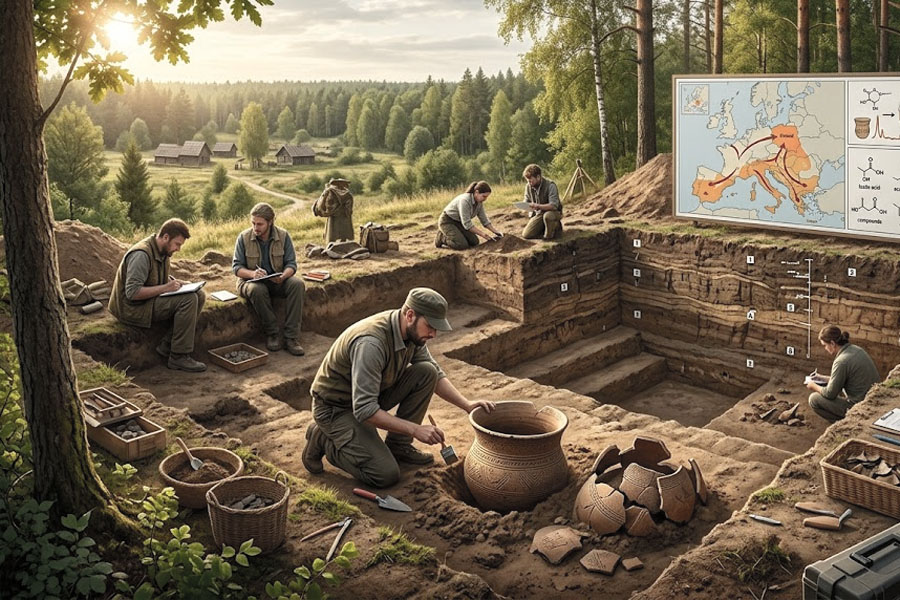
Ancestral Spirits: Oldest Evidence of Alcohol Consumption Found in Poland Redefines European Prehistory
Archaeology frequently delivers surprises that force us to re-evaluate the foundations of human civilization. A recent discovery in Poland, published in the journal Archaeometry, has become a scientific sensation. Researchers have identified chemical traces of alcoholic beverages on ceramic shards dating back more than 5,000 years. This is not merely the discovery of ancient pottery; it is undeniable proof that the early farmers of Central Europe possessed sophisticated fermentation technologies long before the first city-states of Mesopotamia were built. As Chief Editor, I emphasize: this discovery demonstrates that alcohol was not just a food product but a powerful social catalyst that shaped the structure of Neolithic society [1, 3].
Molecular Archaeology: How Scientists Made Ancient Ceramics “Talk”
Detecting alcohol in millennia-old artifacts is an exceptionally complex task because the liquid evaporated long ago. The success of Polish archaeologists was made possible by the application of Gas Chromatography-Mass Spectrometry (GC-MS), which allows for the identification of microscopic organic residues absorbed into porous clay.
- Fermentation Markers: Traces of tartaric and succinic acids, as well as specific plant sugars, were found within the ceramic pores.
- Funnelbeaker Culture: The findings belong to one of the most influential Neolithic cultures, which were among the first to use ceramics for mass food storage.
- Cereal Substrate: Analysis revealed traces of barley and wheat, indicating the production of a primitive beer or ale.
- Fruit Additives: Some samples contained residues of wild berries, used to accelerate fermentation and enhance flavor.
Social Glue of the Neolithic: Why Did Ancient People Need Alcohol?
The transition from hunting and gathering to farming is often linked to food security. However, the discovery in Poland supports the “Beer Theory” of civilization: perhaps humans began cultivating grain not for bread, but for the production of celebratory beverages.
- Ritual Significance: Shared consumption of alcohol strengthened bonds between communities and was used in religious ceremonies.
- Sanitary Function: Fermented drinks were safer than water from open sources, as the fermentation process killed pathogenic bacteria.
- Energy Storage: Beer served as a liquid calorie concentrate that was easier to preserve and distribute during winter periods.
Comparative Chronology: Earliest Global Evidence of Alcohol
To grasp the significance of the Polish find, we have designed a table comparing the emergence of alcohol across different global regions based on the latest archaeological data.
| Region / Country | Approximate Date | Type of Beverage | Detection Method |
|---|---|---|---|
| China (Jiahu) | 7000 BCE | Rice, honey, and fruit mixture | Biochemical residue analysis |
| Georgia (Gadachrili Gora) | 6000 BCE | Grape wine | Tartaric acid traces on ceramics |
| Poland (New Discovery) | 3500–3000 BCE | Cereal beer / Mead | GC-MS analysis of porous clay |
| Armenia (Areni-1) | 4000 BCE | Grape wine | Cave-based winery complex |
| Mesopotamia (Sumer) | 3000 BCE | Barley beer | Cuneiform recipes and depictions |
Impact on Modernity: From Neolithic Bowls to Craft Breweries
The Polish discovery underscores that the taste for fermented beverages is genetically embedded in our culture. The ancient methods uncovered by archaeologists resonate in modern craft alcohol production, where wild yeasts and natural additives are still prized.
- Recipe Reconstruction: Brewers are already attempting to recreate “Neolithic Ale” based on the identified markers.
- Migration Patterns: The spread of brewing technology helps trace the migration routes of the first farmers across Europe.
- Genetics: The study correlates with data on the evolution of enzymes in Europeans that allow for ethanol metabolism.
Geographic Context: Why Poland?
The territory of modern Poland during the Neolithic was a cultural melting pot. The fertile loess plateau soils fostered grain surpluses, creating ideal conditions for fermentation experiments. Sites like Bronocice or Kujawy continue to provide science with unique data on ancestral life [1, 3].
FAQ: Frequently Asked Questions about the Ancient Alcohol Discovery in Poland
- What kind of alcohol did ancient Polish inhabitants drink? Analysis points to a beverage similar to modern unfiltered ale, made from wheat and barley with added honey or berries.
- How did scientists know the vessels contained alcohol? Using gas chromatography, they found molecular fermentation markers preserved in ceramic pores for thousands of years.
- Was this beverage strong? Most likely, its alcohol content did not exceed 3-5%, as wild yeasts cannot produce high concentrations of spirits.
- Does this mean Poland is the birthplace of beer? No, beer appeared earlier in the Middle East and China, but this find is the oldest evidence for Northern and Central Europe.
- Did ancient people use hops? No, hops were introduced to brewing much later, in the Middle Ages. Neolithic people used herbs and berries for flavoring.
- Who drank this alcohol—everyone or just the chiefs? Archaeologists believe that in the Neolithic, alcohol was a part of collective celebrations accessible to the whole community.
- Does this discovery help modern science? Yes, it expands our knowledge of ancient food biochemistry and the evolution of human nutrition.
- Can I taste such a drink today? Some historical breweries produce limited editions of beverages brewed using reconstructed Neolithic technologies.
- How did this alcohol affect the health of ancient people? In moderation, it was a source of calories, B-vitamins, and a safe fluid source.
- Will excavations continue? Yes, Polish scientists plan to expand the search areas in hopes of finding entire “breweries” from that era.