

From Womb to Infancy: How Science is Redefining Down Syndrome Brain Development
For decades, the medical community viewed the cognitive challenges associated with Down syndrome (DS) primarily through the lens of neurodegeneration in adults. However, a wave of pioneering research in the United States is shifting the focus to the very beginning of life. New cellular maps and imaging studies are revealing that Trisomy 21 reshapes the brain’s architecture long before a child takes their first breath.
The Prenatal Blueprint: A Rushed Sequence
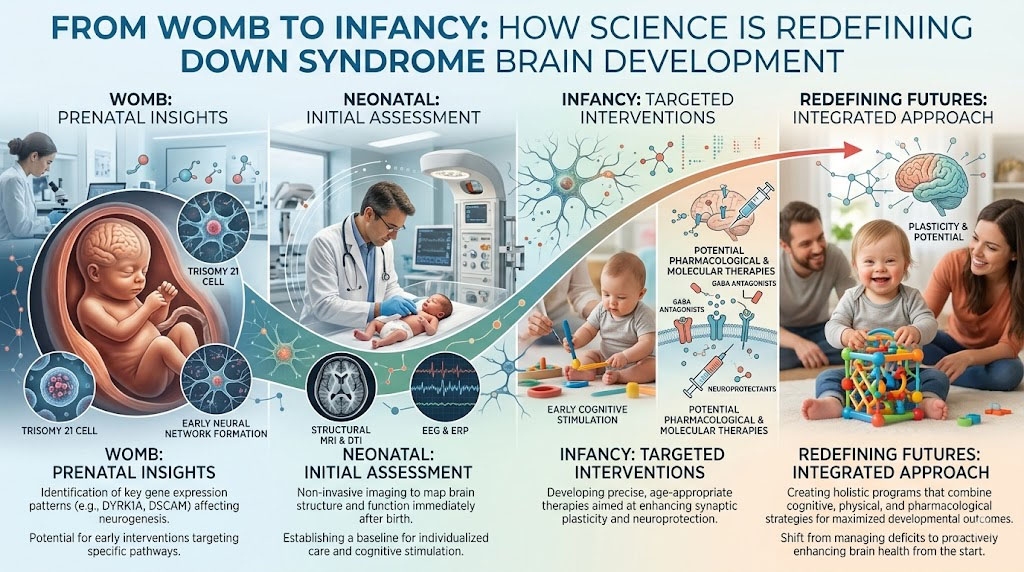
Recent studies at UCLA have produced the first high-resolution molecular maps of the developing prenatal brain in Down syndrome. By analyzing over 100,000 cell nuclei, researchers discovered that Trisomy 21 disrupts the “tightly orchestrated sequence” of brain development.
In typical development, brain stem cells (progenitor cells) divide many times to build a large pool before turning into neurons. In Down syndrome, these cells prematurely “rush” into neuron production. This exhaustion of the progenitor pool explains why individuals with DS often have smaller brain volumes — a finding that debunks the long-held theory that brain size was reduced due to widespread cell death. Furthermore, this shift skews the balance of neurons, favoring those that connect the two hemispheres over those that process sensory and motor information.
Infancy and the Wiring of the Brain
The alterations continue into infancy. Research from the Infant Brain Imaging Study (IBIS) Network has identified significant microstructural changes in the white matter of 6-month-old infants with DS. Using advanced MRI techniques like Diffusion Tensor Imaging (DTI) and NODDI, scientists found reduced structural integrity and neurite density in tracts critical for language and executive function, such as the inferior fronto-occipital fasciculus.
These findings are crucial because they suggest that the brain’s “wiring” differences emerge extremely early, providing a potential window for “mechanistically-informed interventions” aimed at improving long-term cognitive outcomes.
The Frontier: CRISPR and New Therapeutics
The horizon for treatment is also expanding. In a landmark laboratory breakthrough, scientists recently used CRISPR technology to “deactivate” the extra 21st chromosome in human cells. While clinical application remains in the future, this proves that the root cause of the syndrome — not just its symptoms — can be targeted. Additionally, identifying specific prenatal pathways allows for the possibility of future gene therapies or drug treatments designed to restore typical development.
The Ethical Landscape in the U.S.
As science advances, so does the ethical debate. In the U.S., the rise of high-precision prenatal screening (NIPT) has created a paradox: while society moves toward greater inclusion and the use of empowering terms like “differently abled,” the rate of selective termination following a DS diagnosis remains high, approximately 92% in some studies. Experts emphasize the need for non-directive, expert-led counseling to ensure parents receive unbiased information about the potential for individuals with DS to lead fulfilling, independent lives.