


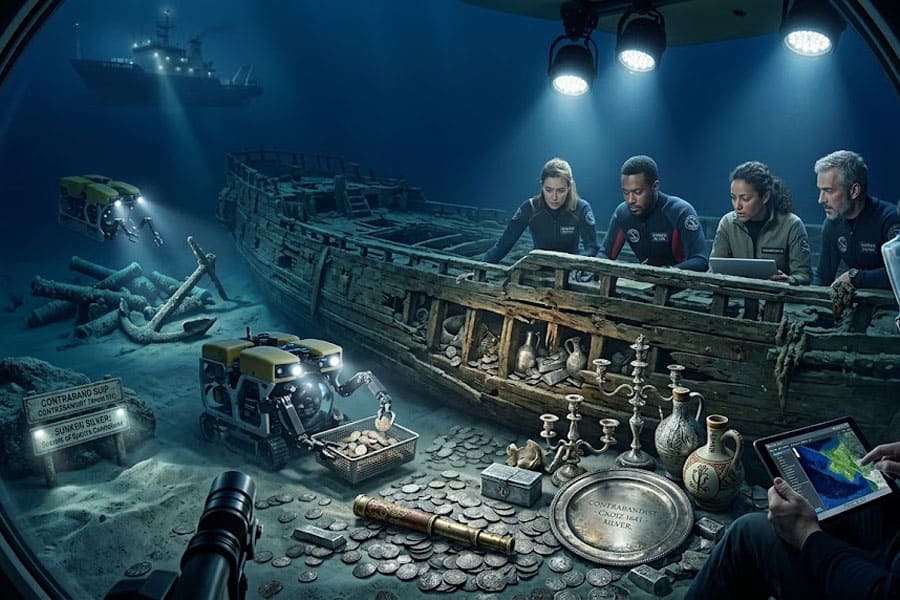
Sunken Silver: Secrets of Spain’s 17th Century Contraband Ship
Maritime archaeology often presents surprises in the most unexpected places. During routine dredging operations for the expansion of a container port in Cadiz, Spain, workers stumbled upon the remains of an ancient vessel that had rested beneath layers of silt for decades. This find, temporarily named Delta I, turned out to be more than just a pile of old wood; it is a genuine time capsule revealing the golden age of contraband and naval warfare.
Off the coast of Spain, a 17th-century ship with silver and cannons was discovered, which experts believe was part of a secret illegal trade network. Onboard, researchers found an impressive arsenal of 27 cannons and 18 massive silver ingots weighing approximately half a ton. This discovery sheds light on the shadow economy of the Atlantic during an era when the Spanish Crown attempted to strictly control every gram of precious metal arriving from the New World.
The uniqueness of this discovery lies in its demonstration of the surprising interconnectedness of European nations at that time. A French vessel, Swedish cannons, Dutch intermediaries, and Spanish silver all converged at a single point on the floor of the Bay of Cadiz. For modern historians, this is not just a treasure but a complex puzzle that helps reconstruct the real picture of 17th-century world trade, which often bypassed official laws and taxes.
Underwater Discovery in the Heart of Cadiz Bay
Cadiz has always been a key node for maritime routes. Its natural harbor served as a gateway for fleets returning from the Americas with gold and silver. It was here, within the port area, that archaeologists from the Center for Underwater Archaeology of the Andalusian Institute of Historical Heritage discovered the remains of the ship. The investigation was led by experienced specialists Ernesto Toboso Suárez and Josefa Martí Solano, who had to work under the challenging conditions of an active port.
Port expansion projects involve heavy machinery used for deepening the seabed. Unfortunately, such works often damage archaeological sites. In the case of Delta I, scientists describe the find as “taken out of context.” This means that many artifacts were moved from their original locations by dredging buckets, making it difficult to accurately reconstruct the ship’s position at the time of the wreck.
Key features of the discovery site:
- Location: Bay of Cadiz, port expansion zone.
- Object condition: Fragmentary, damaged by dredging works.
- Ship type: Built in Ibero-Atlantic traditions, likely of French origin.
- Preliminary dating: Third quarter of the 17th century.
A unique fact is that one of the silver ingots found has a clear marking with a date—1667. This allows scientists to determine with high precision when the ship was in operation and narrow down the historical events it might have been involved in. In archaeology, such “signed” items are valued immensely, as they replace entire volumes of archival documents.
Practical conclusion for history buffs: Such finds remind us of the importance of professional oversight during construction in historical zones. Without archaeological intervention, these cannons and silver might have ended up in soil dumps, lost to science forever. Without the vigilance of specialists, one of the most important chapters of Andalusia’s maritime history would have remained untold.
Complex term explanation: Dredging is the process of removing soil from the bottom of a water body to increase the depth of a channel or port area. This is necessary for huge modern container ships to safely enter the harbor without running aground.
Artillery Arsenal and the Swedish Trail
One of the most impressive details of the find was the cannons. A total of 27 artillery pieces of various calibers were documented. Research showed that these cannons have Swedish origins but were likely purchased through Dutch intermediaries. This is a classic example of the 17th-century pan-European arms market, where political disagreements often gave way to commercial benefit.
Archaeologists found that many cannons are in poor condition. Some are missing muzzles or trunnions—special side projections used to mount the gun on a carriage. The fact that no remains of wooden carriages were found on-site led scientists to an interesting thought. It is quite possible that some of these cannons were already defective and were being transported as ballast for the ship’s stability.
Interesting facts about the Delta I artillery:
- Guns of five different calibers were found.
- The dating of the cannons coincides with the third quarter of the 1600s.
- The absence of carriages indicates specific use of the guns.
- Damage may be the result of battle or wear and tear.
Real-life example: Imagine a modern truck carrying a load of spare parts while using old, non-functional engines as weight for better road grip. This is likely how the damaged cannons on Delta I were used. They were heavy, durable, and perfect for keeping the ship from capsizing in a storm when the main cargo (silver) was not very bulky.
Comparison: Swedish steel and iron in the 17th century were considered the standard of quality, much like German engineering is valued today. Swedish factories supplied weapons to almost all warring countries in Europe, creating a kind of “military supermarket” of the time. The presence of such cannons on a French ship off the coast of Spain is direct evidence of past economic globalization.
Complex term explanation: Trunnions are cylindrical protrusions on the sides of a cannon barrel. They served as the axis on which the cannon could pivot up and down for aiming. If the trunnions are broken off, the cannon is almost impossible to mount for firing, making it useless in battle but still valuable as scrap metal or cargo.
Contraband Silver: The Empire’s Shadow Economy
While the cannons were protection or ballast, the 18 silver ingots were the true goal of the voyage. The weight of this “treasure” is about 500 kilograms. In the 17th century, the Spanish Crown established a monopoly on trade with colonies in America. All precious metals had to pass through official customs in Seville, and later in Cadiz, where a significant tax—the “quinto real” (the royal fifth)—was levied.
However, high taxes always give rise to a desire to bypass them. Researchers suspect that the silver on Delta I was part of an illegal smuggling operation. Foreign ships, especially French and Dutch, often anchored in secluded areas of the bay to transfer or receive goods without the oversight of royal officials. Cadiz, with its intricate coastline, was an ideal place for such operations.
Comparative characteristics of the cargo and its context:
|
Item
|
Weight/Quantity
|
Origin
|
Likely Purpose
|
|---|---|---|---|
|
Silver ingots
|
~500 kg (18 pcs)
|
Americas (via Cadiz)
|
Contraband export to Europe
|
|
Cast iron cannons
|
27 units
|
Sweden
|
Defense or ballast
|
|
Ship hull
|
Wood fragments
|
France
|
Trade and cargo transport
|
Historical case study: At that time, Cadiz was becoming a powerful commercial hub. Officially, trade was controlled by the state, but in reality, the city was teeming with agents of foreign trading houses. Contraband was so massive that, by some estimates, up to a third of all silver from the New World left Spain illegally. The discovery of Delta I is material confirmation of this “black bookkeeping” of the past.
Conclusion for understanding the situation: The presence of silver along with weapons highlights the risky nature of Atlantic travel. Smugglers had to be prepared not only for encounters with customs officers but also for attacks by pirates or warships of hostile powers. Every such voyage was a gamble with death, where fabulous wealth was at stake.
Analogy: The work of 17th-century smugglers can be compared to modern offshore schemes. Instead of paying taxes to the state treasury, merchants looked for ways to “export” funds to other countries using front vessels and complex routes. Delta I was one of these tools for “tax optimization” three hundred years ago.
Historical Context and Great Galleons
To appreciate the scale of the find in Cadiz, it is worth comparing it with other famous shipwrecks. For example, the legendary galleon San José, found off the coast of Colombia, is considered the richest sunken ship in history. Its cargo is estimated in the billions of dollars. Delta I is more modest in terms of jewelry volume, but it is no less important for science as it represents a different type of vessel—not a huge military transport, but likely a nimble rogue merchant ship.
The events of the second half of the 17th century were a time of constant conflict between Spain, France, and England. The Atlantic was an arena for economic dominance. Spain was gradually losing its power, and foreign powers were increasingly penetrating its trade networks. The French origin of Delta I suggests that even during periods of war, trade ties were not broken but simply went underground.
Main factors affecting maritime trade in the 1660s:
- Political rivalry of European monarchies for colonies.
- Strict regulation of precious metal trade by Spain.
- Active development of Swedish metallurgy and Dutch mediation.
- Frequent storms and navigational errors in the dangerous waters of Cadiz Bay.
Unique fact: The vessel was built in so-called Ibero-Atlantic traditions. This special style of shipbuilding combined features of Mediterranean galleons and northern Atlantic vessels. This made such ships hardy and capable of crossing the ocean while remaining maneuverable enough to enter shallow bays.
Comparison with San José: If San José was a “floating fortress” of the royal fleet, Delta I was likely a “private entrepreneur.” Her demise in the Bay of Cadiz might have been caused not by an enemy attack but by an ordinary storm or a pilot’s error while trying to covertly enter the port under the cover of night.
Practical application of knowledge: For historians, analyzing the wood composition and construction of Delta I allows for clarification on how shipbuilders’ engineering thoughts changed under the influence of constant wars. This helps us understand how technologies developed that eventually led to the creation of the great fleets of the Enlightenment era.
Study Results and Significance for Andalusia
The discovery of Delta I in the Bay of Cadiz is a major event for Spanish underwater archaeology in recent decades. It confirms that the bottom of our seas still hides many secrets capable of changing our perception of the past. Despite the damage caused by modern machinery, the artifacts were successfully rescued and handed over to scientists.
Main conclusions based on the results of the work:
- The existence of active contraband networks in the 17th-century Atlantic, involving French ships, was confirmed.
- A complex supply route of weapons from Sweden via Holland was identified, indicating a high level of European market integration.
- The found silver ingots with a date of 1667 serve as a reliable anchor for dating other objects and the shipwreck itself.
- Archaeologists proved the necessity of monitoring dredging works in historical harbors to preserve cultural heritage.
- The discovery provides new data on the types of vessels used for illegal trade bypassing Spanish tax authorities.
Today, scientists continue to work on identifying the vessel. It may be possible to find documents in the archives of France or Spain mentioning the loss of a ship with a similar cargo in the 1660s or 1670s. For now, Delta I remains a silent but extremely eloquent witness to an era when silver and cannons ruled the world.
For the residents of Cadiz and all of Andalusia, this discovery is a source of pride in their rich history. It is another reminder that beneath our feet (and underwater) lies a whole universe waiting for its researcher.
FAQ — Frequently Asked Questions
1. What exactly did archaeologists find in the Bay of Cadiz? The remains of a 17th-century ship were found, which carried 27 cannons and 18 silver ingots. The find was made accidentally during work to expand a commercial port. Scientists also found fragments of the ship’s hull built using Ibero-Atlantic technologies.
2. What is the weight of the silver found and what is its value? The total weight of the 18 ingots is approximately half a ton (500 kilograms). The historical value of these items is immeasurable, as they allow for the study of the smuggling system of that time. Markings on one of the ingots point to the year 1667.
3. Why do scientists consider this ship a contraband vessel? The Spanish Crown strictly controlled the import of silver through official ports and levied high taxes. The combination of a French vessel, Swedish weapons, and a large amount of silver in Cadiz Bay without official documents points to an attempt to bypass the royal monopoly.
4. Where did the Swedish cannons on the ship come from? Sweden in the 17th century was a leading producer of high-quality artillery in Europe. Cannons were often sold through Dutch intermediaries, who had the most developed trade network. This explains how Swedish weapons ended up on a French ship off the coast of Spain.
5. What does the name “Delta I” mean? This is a temporary technical designation assigned to the vessel by archaeologists for documentation convenience. The ship’s real name remains unknown for now, and researchers hope to find it in historical archives.
6. Was the find damaged by port construction work? Yes, dredging works partially damaged the site and moved artifacts from their original locations. Archaeologists call such finds “taken out of context” because it is difficult to determine the exact placement of objects on deck or in the hold at the time of the wreck.
7. What is the fate of the found artifacts now? All cannons and silver ingots have been brought to the surface and transferred to the Center for Underwater Archaeology of Andalusia. They are undergoing a process of conservation and study. In the future, there are plans to display them in one of the local museums, such as the Museum of Cadiz.