

The Unseen Architect: How Malaria Directed the Path of Human History
For millennia, human history has been viewed through the lens of climate, war, and politics. However, groundbreaking research now reveals that one of our oldest and deadliest enemies—the malaria parasite—was a fundamental factor shaping the deep history of our species. From the dense forests of prehistoric Africa to the bustling ports of the Roman Empire, malaria has acted as an invisible architect, directing where we lived, how we moved, and even how our genes evolved.
The Great Fragmenter: Early Migration in Africa
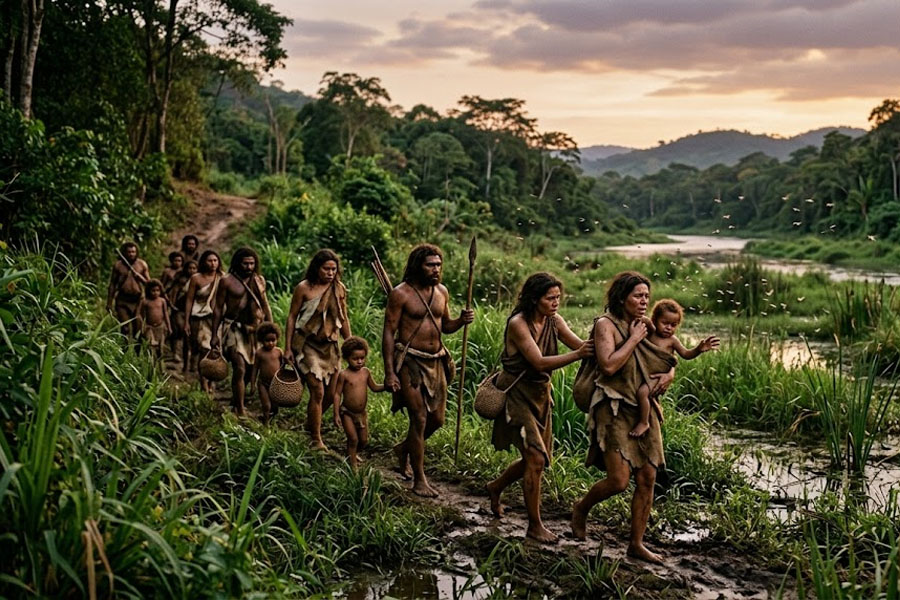
New evidence suggests that Plasmodium falciparum, the most lethal malaria parasite, influenced human habitat choice as far back as 74,000 years ago. Long before the advent of agriculture, ancient humans were forced to navigate a “landscape of fear” created by infectious disease. Species distribution models show that early populations actively avoided high-risk malaria environments.
By pushing human groups away from fertile but mosquito-infested areas, malaria contributed to the fragmentation of early societies. This isolation meant that populations met, mixed, and exchanged genes less frequently, helping to create the complex human population structure we see today. Far from being just a modern challenge, malaria was a decisive force in our species’ earliest prehistory.
The Agricultural Paradox
The relationship between humans and malaria shifted dramatically with the dawn of agriculture roughly 10,000 years ago. As hunter-gatherers began clearing forests for crops, they unwittingly created the perfect breeding grounds for Anopheles mosquitoes. Sunlight-drenched freshwater pools, a byproduct of deforestation, led to an explosion in mosquito populations.
While agriculture provided the food surplus necessary for civilization, it also fueled a malaria pandemic. Genetic studies indicate that the mutation (sickle cell trait), which provides partial protection against malaria, emerged in Africa at least 20,000 years ago—much earlier than previously thought. As farming communities migrated across the continent, they carried these protective mutations with them, demonstrating how disease resistance became a biological necessity for survival.
Malaria and the Fall of Empires
As humans migrated out of Africa into the Mediterranean and beyond, malaria followed. Recent analysis of 2,000-year-old human remains from Italy has confirmed that P. falciparum was a significant pathogen during the Roman Empire. Mitochondrial DNA extracted from the teeth of bodies in ancient cemeteries provides “overwhelming evidence” that malaria plagued both coastal trade centers and inland rural estates.
In Italy, the spread of malaria occurred in waves, often following trade routes from North Africa and Greece. The disease likely contributed to the decline of major Greek colonies and Roman cities, as seen in the rapid abandonment of sites like Paestum. By the time of the late Roman Empire, malaria was so pervasive that it influenced seasonal travel; pilgrims from Northern Europe reportedly timed their visits to Rome to avoid the “bad air” of the summer months.
A Biological Legacy
Our battle with malaria is etched into our very DNA. Protective polymorphisms like G6PD deficiency and thalassemia are highly correlated with regions where malaria was prevalent. These genetic adaptations were the population’s evolutionary response to the extreme selective pressure exerted by the parasite.
Even cultural habits may have been shaped by this struggle. In ancient Egypt, the Denderah temple contains one of the oldest preventive precepts: “Beware of going outside home after the sunset, during the weeks following Nile river floods”. This shows an early, sophisticated understanding of the link between the environment and disease.
Today, malaria remains a global threat, causing nearly 450,000 deaths annually. Understanding its evolutionary path—from its origins 5-7 million years ago to its role in shaping modern genomes—is not just a matter of historical curiosity; it is a vital tool in our ongoing fight against this persistent pathogen.