


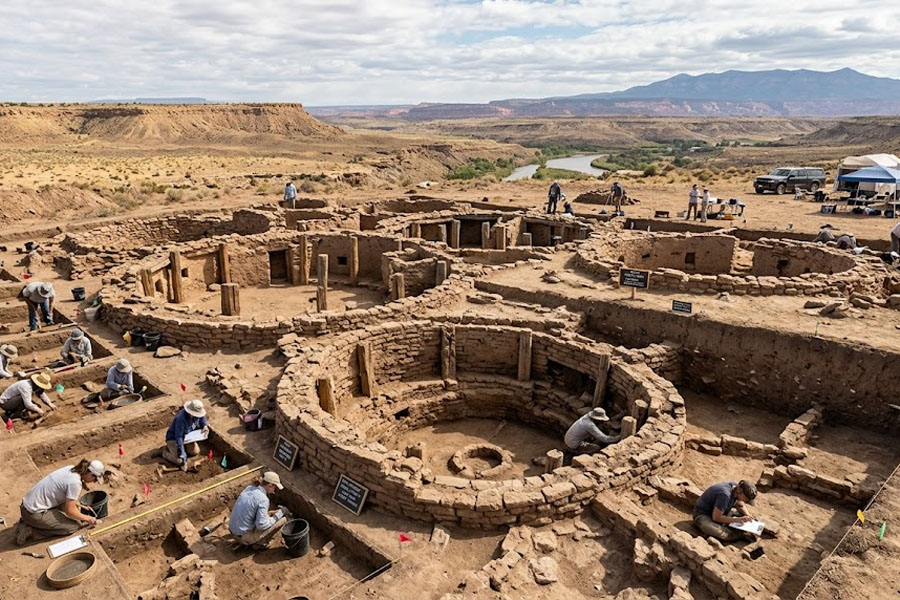
The Triquet Island Enigma: How a 14,000-Year-Old North American Settlement Upended Ancient History
For decades, the narrative of the Americas’ peopling was built on the “Clovis First” theory, suggesting humans arrived about 13,000 years ago via an inland ice-free corridor. However, a groundbreaking discovery on Triquet Island, British Columbia, has delivered a fatal blow to this paradigm. Archaeologists have unearthed remains of a settlement radiocarbon-dated to an astonishing 14,000 years old. This means that while Egypt’s Great Pyramids were still thousands of years from being conceived, a sophisticated seafaring culture was already thriving in North America. This discovery does more than just extend the timeline of human history—it validates the oral traditions of indigenous nations that Western science dismissed for a century. We explore how these ancient pioneers survived the Ice Age and why this find redefines human migration patterns. This is the molecular evidence of a 14,000-year-old lineage.
Molecular Dating: Why 14,000 Years Changes Everything
The success of the Triquet Island excavation was a result of collaboration between University of Victoria researchers and the Heiltsuk Nation. By digging through meters of peat and soil, scientists found ancient charcoal from a hearth that served as the key to precise dating.
- Radiocarbon Confirmation: Charcoal particles proved that humans were lighting fires at this site 14,000 years ago.
- Coastal Migration Theory: The find supports the hypothesis that the first Americans bypassed the frozen interior, moving along the ice-free coast by boat.
- Heiltsuk Oral History: The Heiltsuk people have long maintained that their ancestors fled to a “piece of land that never froze.” Science has now confirmed that Triquet Island was indeed a glacial refugium.
- Advanced Tools: Excavators found complex fish hooks, spears, and specialized equipment for hunting marine mammals.
Ice Age Technology: How Did the First Americans Live?
Life 14,000 years ago required extraordinary survival skills. The artifacts found on the island suggest that these ancient inhabitants were not merely opportunistic hunters but skilled engineers and mariners.
- Marine-Based Economy: A massive quantity of seal and sea lion bones indicates a diet and economy heavily reliant on the ocean.
- Resource Ingenuity: With limited timber due to the cold climate, inhabitants used stone and bone to create durable tools and shelter frames.
- Trade Networks: Analysis of obsidian tools revealed the material was sourced from mainland sites, suggesting established long-distance logistics or trade.
Comparative Chronology: Triquet Island vs. Global Landmarks
To grasp the profound antiquity of this site, we have designed a table comparing the age of the Canadian settlement with humanity’s most famous historical monuments.
| Site / Culture | Location | Approximate Age | Historical Significance |
|---|---|---|---|
| Triquet Island Settlement | Canada (British Columbia) | 14,000 Years | Oldest coastal settlement in the Americas |
| Göbekli Tepe | Turkey | 11,500 Years | World’s first temple complex |
| Pyramid of Djoser | Egypt | 4,700 Years | Oldest Egyptian pyramid |
| Stonehenge | United Kingdom | 5,000 Years | Major megalithic stone circle |
| Wall of Jericho | Palestine | 10,000 Years | Oldest defensive city wall |
Modern Impact: Land Rights and Scientific Recognition
The Triquet Island discovery carries significant political weight alongside its scientific value. It has become a crucial legal instrument for indigenous nations in Canada protecting their ancestral lands.
- Legal Precedent: Archaeological proof of 14,000 years of continuous habitation strengthens the Heiltsuk Nation’s position in government negotiations.
- Cultural Revival: Younger generations of indigenous communities now have scientific backing for their oral histories, sparking renewed interest in traditional practices.
- Climate Insight: Studying the ancient site helps researchers understand how coastal ecosystems adapted to past rapid climate shifts.
Why This Discovery Outshines the “Pyramid” Myth
For too long, “civilized” history was viewed as a monopoly of Eurasia and Egypt. The North American find shatters this Eurocentric perspective. It proves that complex social structures existed in the New World 9,000 years before the first Pharaoh rose to power. This was a society that survived the Ice Age, cataclysmic floods, and shifting sea levels, preserving its identity in oral stories until the present day.
FAQ: Frequently Asked Questions about the Triquet Island Settlement
- Is the settlement really older than the Egyptian pyramids? Yes, it is approximately three times older than the earliest Egyptian pyramids.
- How was the age determined? Scientists used radiocarbon dating on charcoal found in ancient cooking hearths.
- Who lived on the island? The ancestors of the Heiltsuk people, an indigenous nation of coastal British Columbia.
- Why didn’t the settlement freeze during the Ice Age? It was located in a “refugium”—an area that remained ice-free due to specific ocean currents and topography.
- What artifacts were found? Fish hooks, spear points, stone tools for hide processing, and hearth remains.
- How did people reach the island 14,000 years ago? They likely used boats, moving along the “Kelp Highway” from Asia via Beringia.
- Can I visit Triquet Island today? The island is protected, and access is restricted to preserve the archaeological layers and respect indigenous rights.
- What does this mean for American history? It disproves the theory that humans only entered the Americas after the continental ice sheets melted.
- Were any houses found? While wooden structures haven’t survived, soil analysis shows consistent patterns of long-term habitation and hearth placement.
- Are excavations still ongoing? Yes, researchers continue to explore the coastline, hoping to find even older evidence of human presence.