

Ageism and Andragogy: How Education Destroys Social Stereotypes
Ageism, a term coined by Robert Butler in 1969, refers to discrimination based on a person’s age. In modern society, this often manifests as a dismissive attitude toward older adults, who are stereotyped as slow, rigid, or resistant to change. Psychologically, this prejudice is deeply rooted in Terror Management Theory (TMT), where ageism serves as a defense mechanism against existential anxiety and the fear of mortality.
The Biological Reality: Neurogenesis throughout Life
For decades, the scientific dogma suggested that the adult brain was incapable of generating new neurons. However, research into adult neurogenesis has proven that neural stem cells in the hippocampus continue to produce new neurons throughout an individual’s life. These “immature” neurons form a “brain reserve” that can be utilized to maintain cognitive functions, enhance memory, and delay aging. Cognitive abilities in individuals over 50 are often comparable to those in their 20s or 30s when experience-based strategies and extensive vocabulary are considered.
Andragogy as a Catalyst for Change Andragogy
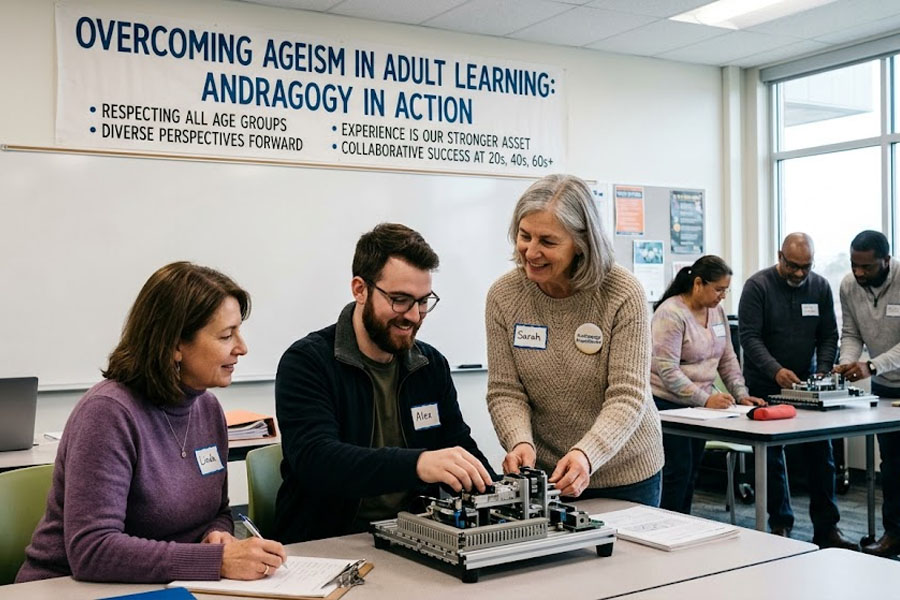
The science of adult education, provides the necessary framework to dismantle ageist barriers. Unlike pedagogy, which centers on the teacher’s authority, the andragogical model emphasizes the learner’s autonomy. Key principles include:
- Practical Orientation: Adult learners are motivated by the immediate application of knowledge to solve real-world problems.
- Wealth of Experience: An adult’s past experiences are a rich resource for learning rather than an obstacle.
- Collaborative Spirit: The educator acts as a consultant or facilitator, fostering a relationship of equality.
While cognitive rigidity—the difficulty of adapting to new situational requirements—can be a challenge, it is not an inevitable consequence of aging. Innovative methods like “hackathons,” “meetups,” and “gamification” can effectively re-engage adult learners and sharpen their cognitive flexibility.
The Economic and Social Impact
Ageism is not just a social issue; it is an economic one. Workplace discrimination deprives the economy of valuable skills and experience. Conversely, companies that embrace age diversity and foster multi-generational teams (mixing “Boomers” and “Gen Z”) often achieve superior financial results. The combination of senior loyalty and problem-solving skills with the digital fluency of younger workers creates a potent synergy.
Conclusion Lifelong learning is the most effective weapon against ageism. By applying andragogical principles and understanding the brain’s lifelong potential for growth, we can create a society where age is no longer a criterion for competence. Education remains the bridge between the fear of aging and the joy of continuous self-development.