


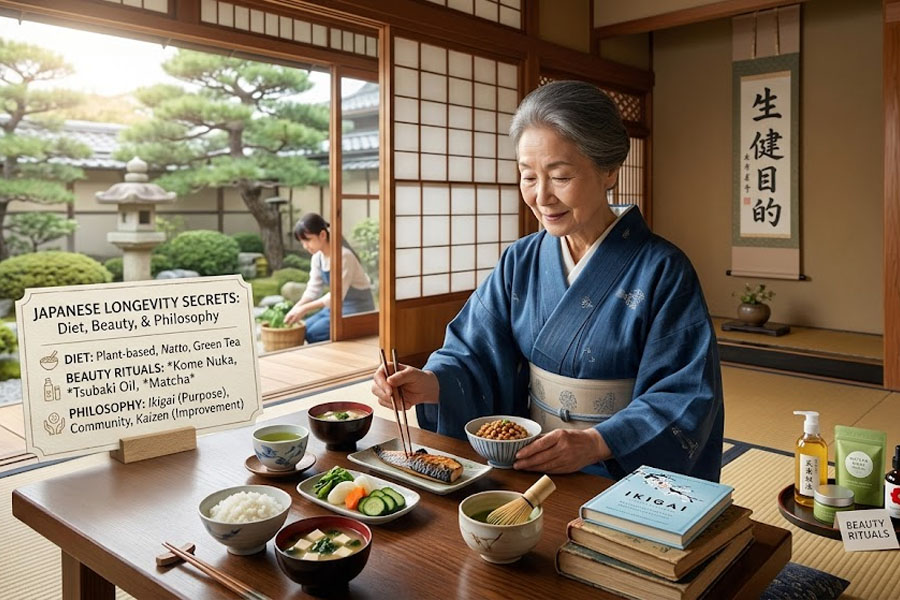
Okinawa, the largest island in Japan’s Ryukyu archipelago, has long been a focal point for researchers due to its record number of centenarians who remain free from chronic diseases. While the Western world searches for youth in capsules, the Japanese simply eat what their ancestors did, continuing to live longer than anyone else on the planet.
1. Golden Rules of Nutrition: “Hara Hachi Bu” and Superfoods
The philosophy of nutrition in Japan is not about restriction but moderation. The core principle is “Hara Hachi Bu,” which means “eat until you are 80% full”. Since it takes the brain 15-20 minutes to register fullness, this practice prevents overeating and lowers the risk of heart disease and dementia.
Scientists have identified five key products in the Japanese diet with proven anti-aging effects:
- Purple Sweet Potato: Rich in anthocyanins, powerful antioxidants that protect DNA and neutralize free radicals.
- Fermented Soy (Natto, Miso, Tofu): Provides isoflavones that activate the FOXO3 “longevity gene”.
- Green Tea and Seaweed: This duo triggers autophagy, the process by which cells clean out debris and regenerate.
- Turmeric: Contains curcumin, a natural geroprotector that mimics the effects of caloric restriction.
- Bitter Melon (Goya): Regulates sugar levels, reduces inflammation, and improves metabolism.
2. Japanese Beauty Rituals: Kobido and Shiatsu
Japanese women are famous for their flawless skin, and the secret lies in systematic care. The “4-2-4” cleansing system involves 4 minutes of hydrophilic oil massage, 2 minutes of foam cleansing, and 4 minutes of contrast rinsing with hot and cold water.
For deep rejuvenation, the “Kobido” massage (“Ancient Way of Beauty”) has been used since the 15th century. It works on facial meridians and acupressure points to improve blood flow and balance “Qi” energy. At home, many also use Shiatsu, where finger pressure on specific points around the eyes for just 1 minute helps strengthen muscles and reduce wrinkles.
3. Posture Correction: The Fukutsudzi Method
Japanese manual therapist Toshiki Fukutsudzi proposed that a protruding abdomen is often the result of displaced pelvic bones rather than fat. His method involves lying on a rolled-up towel for 5 minutes a day. This static stretch returns the skeleton to its natural position, mechanically tightening the abdomen and narrowing the waistline.
4. The Art of Rest: Quality Sleep and Inemuri
In Japan, sleep quality is prioritized over duration. People tend to follow natural rhythms, waking up with the first rays of the sun. A unique tradition called “Inemuri”—napping in public—is highly respected as a sign of hard work and helps restore focus during the day. To prepare for deep night rest, the Japanese use practices like “Shinrin-yoku” (forest bathing) and “Anma” massage.
Conclusion The Japanese path to longevity does not require a “magic pill.” It is about consistency and small habits: a bowl of miso soup, a cup of green tea, and moderation in all things. On a molecular level, these practices work to slow the biological processes of aging