

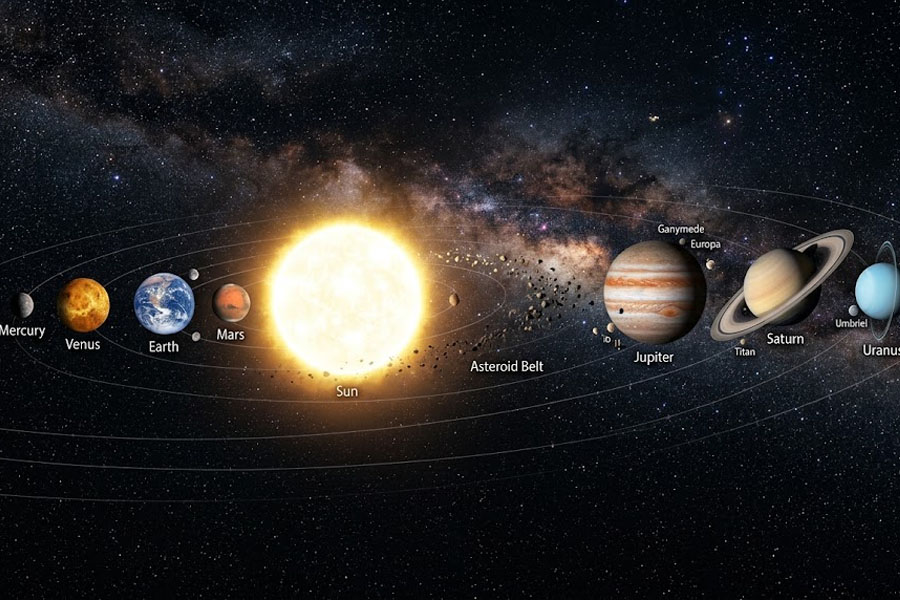
The Cosmic Pivot: Why Jupiter Doesn’t Technically Orbit the Sun
Introduction: A Galactic Misconception Since elementary school, we’ve been taught a simple model of the universe: the Sun sits still at the center, and the planets travel in perfect circles around it. While this is a helpful visualization, the reality of celestial mechanics is far more dynamic. In fact, if you want to be technically accurate, the largest planet in our system—Jupiter—does not orbit the Sun’s center at all. Instead, both the Sun and Jupiter orbit a shared point in space known as the barycenter.
What is a Barycenter? In astronomy, a barycenter is the center of mass around which two or more bodies orbit. Think of it like a seesaw. If a child sits on one end and an adult sits on the other, the balance point (the pivot) must be moved closer to the adult to keep the board level.
In space, gravity works the same way. When a small planet like Earth orbits the massive Sun, the center of mass is located so deep inside the Sun that for all practical purposes, the Sun stays still while Earth goes around it. The Sun-Earth barycenter is a mere 449 km from the Sun’s center—hardly a nudge considering the Sun’s radius is nearly 700,000 km.
The Jupiter Exception Jupiter is a different story. It is a gas giant so massive that it contains 2.5 times the mass of all other planets in the Solar System combined. Because of this incredible bulk and its distance from the Sun (about 5.2 AU), the balance point between the two is pulled outward.
Calculations show that the Sun-Jupiter barycenter lies approximately 742,000 kilometers from the center of the Sun. Since the Sun’s radius is roughly 695,700 kilometers, this pivot point actually sits about 30,000 to 46,000 kilometers above the Sun’s surface. This means that as Jupiter travels through space, the Sun is also moving in a small, reciprocal circle around that empty point in space.
The Sun’s “Wobble” and Finding New Worlds This “hidden pivot” isn’t just a fun fact for trivia night; it is a critical tool for modern astronomers. Because the Sun is forced to orbit the barycenter, it appears to “wobble” from the perspective of a distant observer. By measuring these tiny shifts in a star’s position—a method known as astrometry—or detecting changes in light frequency via the Doppler effect, scientists can find planets orbiting other stars.
Missions like NASA’s SIM PlanetQuest and ESA’s GAIA were designed to detect this exact type of “wobble”. Even though Jupiter’s effect on the Sun is small, it creates an angular diameter shift that can be measured even from 10 parsecs away.
Conclusion: A Shared Dance Does this mean Jupiter isn’t a planet? Of course not. According to the International Astronomical Union (IAU), Jupiter remains one of the eight official planets because it orbits the Sun (in the broader sense) and has cleared its neighborhood. However, the barycenter reminds us that gravity is always a two-way street. The Sun may be the king of our system, but even the King has to dance when Jupiter pulls the strings.