

The Medusa Lake: Why the Waters of Natron Turn Animals to Stone and How Flamingos Thrive
In the heart of the East African Rift in Tanzania lies one of the most terrifying yet mesmerizing bodies of water on Earth—Lake Natron. Famed worldwide for photographs of “calcified” birds and beasts frozen in eternity, this place is shrouded in myth and scientific intrigue. This is not merely a natural anomaly, but a unique geochemical laboratory demonstrating the extreme limits of life’s adaptation.
The Chemistry of Death: Why Flesh Turns to Statue
The “petrification” phenomenon is rooted not in magic, but in a unique combination of volcanic activity and evaporation. The lake is fed by hot springs rich in sodium carbonate (natron), which originates from the nearby Ol Doinyo Lengai volcano. The high concentration of salts and alkalinity turns the water into a caustic brine.
- Extreme pH: The water’s alkalinity can reach levels of 10.5 to 12, comparable to ammonia or bleach.
- Thermal Conditions: Water temperatures in the shallows often rise to 60°C (140°F), literally “cooking” unwary visitors.
- Mummification Effect: Natron was the key reagent used by ancient Egyptians for mummifying pharaohs; it dehydrates tissues and preserves them.
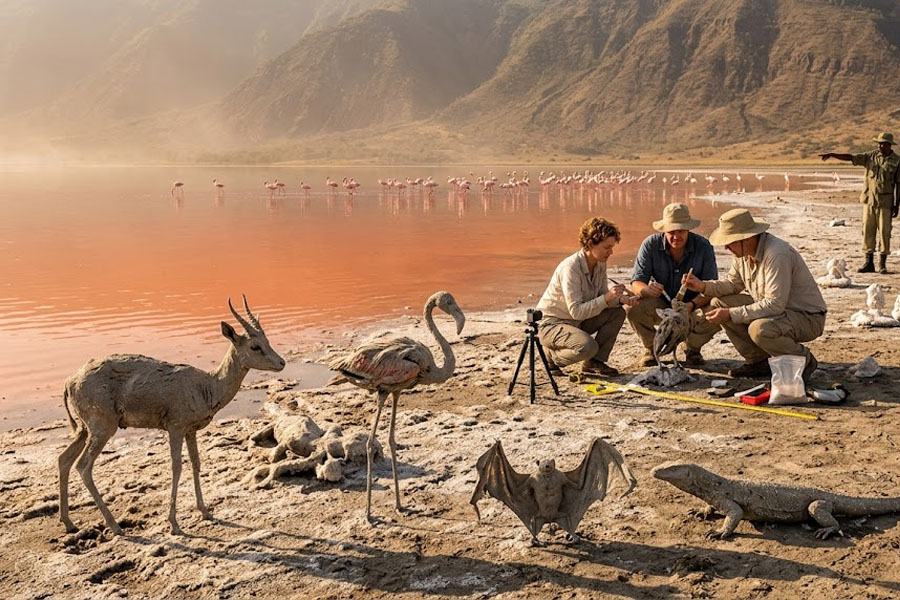
- Calcification: Animals that perish in the lake become coated in calcium salts, creating the illusion of stone statues.
Geological Context: The “Mountain of God” and Its Influence
Lake Natron would not exist without the influence of Ol Doinyo Lengai—the world’s only volcano that erupts natrocarbonatite lava. This creates conditions found nowhere else on Earth. Understanding this context is essential to grasp the region’s uniqueness [2].
- The volcano’s lava is rich in potassium and sodium carbonates but extremely low in silica.
- Rainwater washes these minerals from the volcanic slopes directly into the endorheic lake.
- Intense evaporation in the tropical heat concentrates the saline solution to critical levels.
Life Against All Odds: The Pink Flamingo Paradox
Despite its lethality, Natron is the primary breeding ground for 2.5 million Lesser Flamingos. These birds have found a way to use the aggressive environment as a defensive barrier against predators.
- Natural Protection: Hyenas or lions will not risk entering the caustic water, making the hardened salt islands ideal for nesting.
- Specialized Anatomy: Flamingos’ legs are covered in tough, scaly skin that protects them from chemical burns.
- Nutritional Nieche: The lake teems with cyanobacteria (Arthrospira fusiformis), which give the water its red hue and serve as the birds’ main food source.
Comparative Analysis: Natron vs. A Typical Freshwater Lake
To visualize the ecological differences, here is a characteristic table explaining why Natron is considered one of the harshest environments on the planet [1, 2].
| Parameter | Typical Freshwater Lake | Lake Natron |
|---|---|---|
| pH Level | 6.5 — 8.5 (Neutral) | 10.5 — 12.0 (Extremely Alkaline) |
| Primary Mineral | Silica / Calcium | Natron (Sodium Carbonate) |
| Max. Temperature | 20°C — 30°C | Up to 60°C |
| Main Inhabitants | Diverse fish, amphibians | Cyanobacteria, Flamingos, Alcolapia Tilapia |
| Transparency | High (depending on plankton) | Low, water is often blood-red |
Myths vs. Reality: Do Animals Really Freeze Instantly?
Nick Brandt’s popular photographs created a myth that animals fall into the water and instantly turn to stone. However, the reality is more gradual, though no less fascinating:
- Birds are often disoriented by the lake’s mirror-like surface and crash into the water.
- The alkaline environment prevents decomposition, and the bodies gradually soak in salts.
- Washed-up “mummies” dry in the sun, taking on the appearance of statues.
Evolutionary Significance and the Future of the Lake
Natron is a living reminder of how life can adapt to unthinkable conditions. Scientists study the lake’s extremophiles to understand what life might have been like on early Earth or what it could look like on other planets. However, dam construction and soda ash mining in the region threaten the flamingos’ unique ecosystem [2].
FAQ: Frequently Asked Questions about Lake Natron
- Can humans swim in Lake Natron? Absolutely not. The water causes severe chemical burns to skin and eyes within seconds.
- Is the lake water actually red? Yes, the red or pink color is caused by halophilic microorganisms and cyanobacteria.
- Why don’t flamingos burn their legs? They have unique skin with low permeability and no nerve endings in the lower parts of their legs.
- Where does the natron come from? It is washed from the lava of the nearby Ol Doinyo Lengai volcano.
- Is there fish in the lake? Yes, an endemic fish species—the alkaline tilapia (Alcolapia latilabris)—thrives there, adapted to high temperatures and pH.
- Do animals really turn to stone instantly? No, it is a slow process of mummification and calcification of already deceased creatures.
- Where is the lake located? In northern Tanzania, near the border with Kenya.
- How deep is the lake? It is very shallow, with an average depth of less than 3 meters, which promotes rapid evaporation.
- Is natron used by humans today? Yes, it is mined for the production of soda ash and glass.
- Is it safe for tourists to visit? Yes, but only with professional guides and at a safe distance from the water’s edge.