


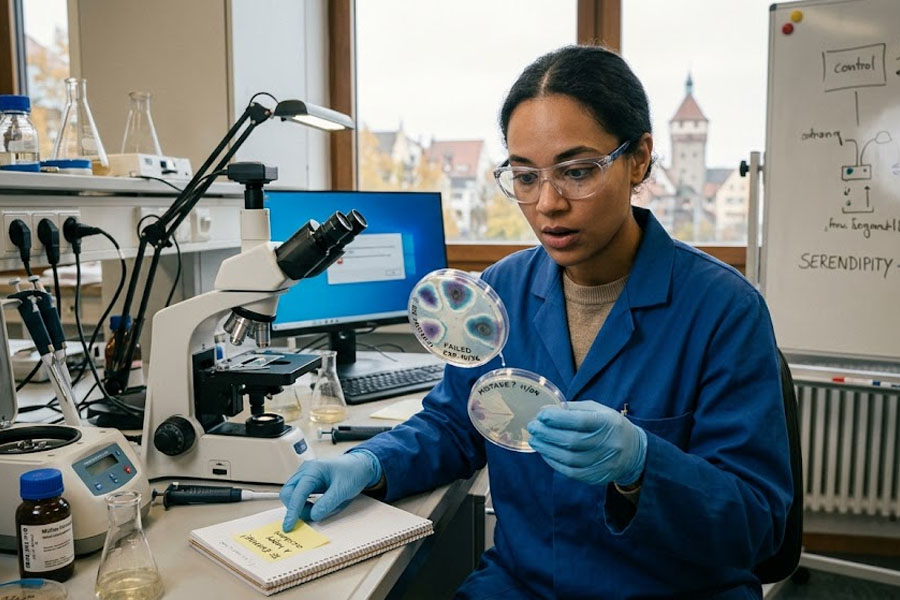
Throughout human history, monumental discoveries have often been the result of unforeseen circumstances rather than rigorous calculation. The ability to draw profound conclusions from random observations and find something one was not intentionally looking for is known as “serendipity”. The term originates from the ancient tale of “The Three Princes of Serendip,” who could describe a lost camel they had never seen simply by observing its tracks. Today, serendipity is recognized as a vital mechanism not only in science but also in the corporate world.
From Medicine to Daily Life: Genius Blunders
One of the most significant examples in medical history is the discovery of penicillin. Alexander Fleming noticed that a mold of the Penicillium genus had destroyed bacteria in a forgotten Petri dish. This “happy accident” marked the beginning of the antibiotic era. Similarly, due to an error in selecting a resistor, Wilson Greatbatch created the world’s first implantable pacemaker when his device began emitting rhythmic pulses that closely mimicked a human heartbeat.
The world of everyday objects is also full of accidental finds. Friction matches were invented by British pharmacist John Walker when he accidentally scraped a stick used for mixing chemicals across his floor. Harry Coover, while attempting to develop plastic lenses for gun sights, accidentally created cyanoacrylate—the base of superglue—which he initially dismissed because it stuck to everything. Teflon was discovered by Roy Plunkett during experiments with refrigerant gases that unexpectedly polymerized into a slippery, heat-resistant substance. Even small conveniences like tea bags appeared by chance: Thomas Sullivan’s customers mistakenly dipped silk sample pouches directly into boiling water.
Culinary Masterpieces: When Kitchen Disasters Succeed
Cooking is an area where mistakes frequently turn into delicacies. Potato chips were born when chef George Speck sliced potatoes paper-thin to spite a demanding customer. The famous French Tarte Tatin resulted from Stephanie Tatin’s attempt to save overcooked apples by simply covering them with pastry and baking them upside down. The Kyiv cake was created because confectioners forgot to refrigerate egg whites and decided to use the hardened mass the next morning.
Business, Risk, and Intuition
Modern business philosophy, represented by thinkers like Nassim Taleb and Gerd Gigerenzer, calls for a rethink of our relationship with uncertainty. Taleb introduced the concept of the “Black Swan”—a rare, unpredictable event that changes everything. He emphasizes the importance of “antifragility,” the ability of a system to grow stronger under the influence of chaos and errors.
Gerd Gigerenzer argues that under conditions of uncertainty, complex logic often yields to simple rules of thumb and intuition. For instance, the “recognition heuristic” allows for correct decision-making based on familiar patterns. A critical factor for success is establishing a “positive error culture,” where mistakes are not hidden but analyzed to gain experience. Evidence shows that psychological safety in a team—where employees are not afraid to take risks and suggest ideas—is essential for high performance.
Conclusion Mistakes are not always a sign of incompetence. Often, they are open doors to the unknown. The ability to trust intuition, accept the right to fail, and capitalize on accidents are skills that make us and our businesses viable in an unpredictable world.